
3D Printed Jewelry Market Size and Share
Market Overview
| Study Period | 2021 - 2031 |
|---|---|
| Market Size (2026) | USD 0.96 Billion |
| Market Size (2031) | USD 2.03 Billion |
| Growth Rate (2026 - 2031) | 12.33 % |
| Fastest Growing Market | Asia-Pacific |
| Largest Market | North America |
| Market Concentration | Medium |
Major Players *Disclaimer: Major Players sorted in no particular order Image © Mordor Intelligence. Reuse requires attribution under CC BY 4.0. | |
3D Printed Jewelry Market Analysis by Mordor Intelligence
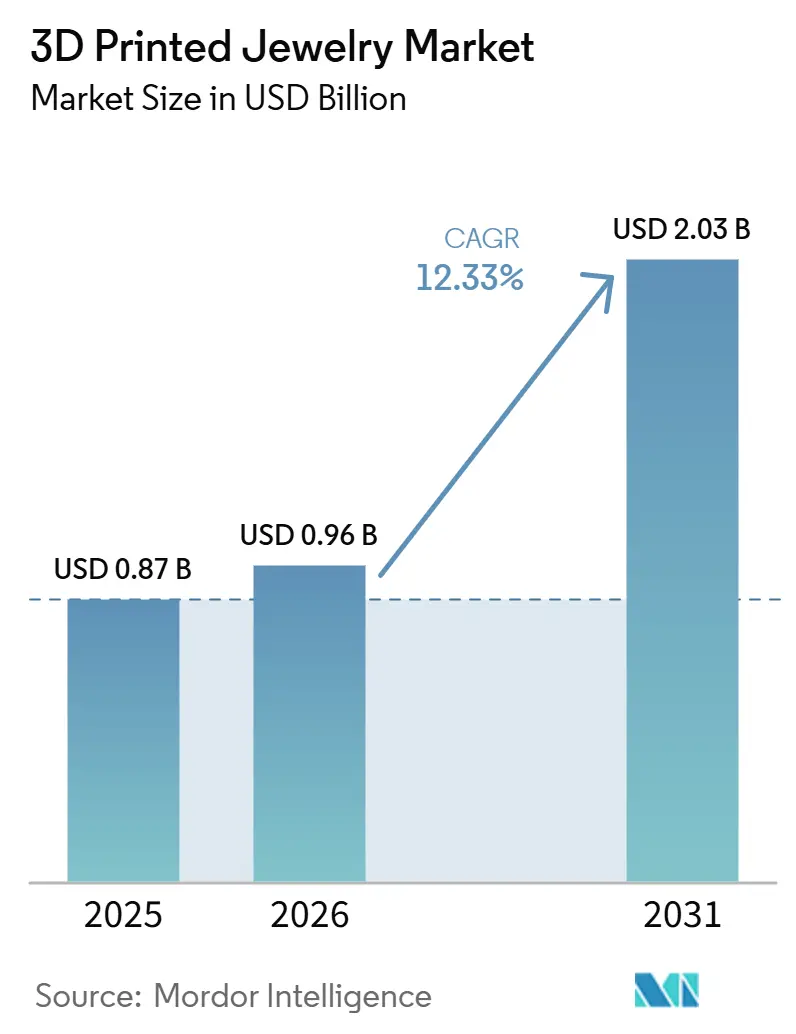
The 3D printed jewelry market size was valued at USD 0.87 billion in 2025 and estimated to grow from USD 0.98 billion in 2026 to reach USD 2.03 billion by 2031, at a CAGR of 12.33% during the forecast period (2026-2031). The 3D printed jewelry market benefits from the convergence of digital design, additive manufacturing, and demand for customized pieces. Faster prototyping allows jewelers to test a design before committing precious metal to production. This supports shorter approval cycles for bespoke orders and reduces avoidable material use during design changes. Hardware, materials, and workflow providers are focusing on print reliability, casting quality, and easier use rather than competing only on equipment price. The 3D printed jewelry market also faces high equipment costs, finishing requirements, and certification demands that favor firms with established technical and compliance capabilities.
Key Report Takeaways
- By product type, rings held 34.29% of revenue in 2025, while necklaces are forecast to grow at a CAGR of 13.47% through 2031.
- By material, resins held 48.26% of revenue in 2025, while mixed materials are forecast to grow at a CAGR of 13.55% through 2031.
- By consumer group, women held 56.48% of revenue in 2025, while unisex jewelry is forecast to grow at a CAGR of 13.78% through 2031.
- By distribution channel, offline stores held 75.68% of revenue in 2025, while online stores are forecast to grow at a CAGR of 14.21% through 2031.
- By geography, North America held 41.29% of revenue in 2025, while Asia-Pacific is forecast to grow at a CAGR of 13.87% through 2031.
Note: Market size and forecast figures in this report are generated using Mordor Intelligence’s proprietary estimation framework, updated with the latest available data and insights as of January 2026.
Market Trends and Insights
Drivers Impact Analysis of 3D Printed Jewelry Market*
| Driver | (~) % Impact on CAGR Forecasts | Geographic Relevance | Impact Timeline |
|---|---|---|---|
| Growing Consumer Preference for Personalized and Bespoke Jewelry | +3.2% | Global, concentrated in North America and Europe | Short term (≤ 2 years) |
| Increasing Adoption of Digital Jewelry Sales Channels and On-Demand Manufacturing | +2.4% | North America & EU core; early-stage in APAC | Short term (≤ 2 years) |
| Accelerating Product Design Cycles and Metal Casting Processes | +1.6% | Global; strongest gains in China and Italy | Medium term (2-4 years) |
| Rising Emphasis on Sustainable Manufacturing and Material Optimization | +1.8% | EU core, spill-over to North America and APAC | Medium term (2-4 years) |
| Increasing Social Media Influence on Consumers | +1.2% | Global; particularly high in Southeast Asia and US | Short term (≤ 2 years) |
| Advancements in Design Automation and AI-Enabled Manufacturability Optimization | +2.0% | North America, South Korea, China | Medium term (2-4 years) |
| Source: Mordor Intelligence | |||
Growing Consumer Preference for Personalized and Bespoke Jewelry
Personalization is changing how jewelry moves from consultation to finished piece. Traditional custom ring fabrication required 2-4 weeks for prototype iteration. SLA-based workflows can turn a consultation into a physical try-on model within 1 hour. This shortens approvals and reduces precious-metal waste caused by early design errors. Engagement rings, wedding bands, and signet rings remain important use cases because buyers often request several design changes before placing an order. Jewelry is increasingly purchased as a personal expression, which supports demand for designs that vary in shape, fit, and detail. Digital production lets a designer revise a model without creating new tooling for every variation. This allows independent studios to offer more options without holding the inventory required by conventional production. The 3D printed jewelry market therefore gains from projects where design iteration has a clear role in the buyer decision. The same workflow also gives casting houses a way to serve clients with complex requests while keeping the physical development process controlled. Personalization remains most valuable when a studio can connect digital design, fit review, and casting in one coordinated process.
Advancements in Design Automation and AI-Enabled Manufacturability Optimization
Design automation is reducing the time required to move from an initial concept to a production-ready model. The workflow is most valuable when a design can be checked for printability and castability before metal is used. The 3D printed jewelry market can benefit when design tools produce files that meet manufacturing limits rather than only visual requirements. This reduces reliance on specialist CAD capacity for routine customization work. It also gives smaller jewelers a practical way to offer a wider range of bespoke options. EOS demonstrated AI-driven adaptive process controls for industrial printing at Hannover Messe in April 2026[1]Source: EOS GmbH, “Robotic Hands From the 3D Printer and AI Powered Production Lines, EOS at Hannover Fair 2026,” EOS, eos.info. Such controls show that established suppliers are linking manufacturing intelligence to equipment capability. Automated checks can help users identify problems earlier in a production sequence. This is important for jewelry because casting defects and failed prints can be costly when precious materials are involved. The 3D printed jewelry market may see wider use of these tools as verified design and production checks become part of standard workflows. This shift supports firms that can make high-quality production accessible without removing the role of experienced jewelers.
Rising Emphasis on Sustainable Manufacturing and Material Optimization
Material efficiency has become a practical consideration for producers handling expensive metals. Additive methods can reduce material use by building a pattern or component only where it is needed. Industrial wax systems with 15-micron layer resolution can help control casting weight more precisely for high-value pieces. The 3D printed jewelry market can use this capability to reduce unnecessary gold use in complex designs. Better control over a design also helps a manufacturer plan production before casting begins. These advantages are especially relevant when material costs make production errors more expensive. A 2024 Springer Nature study described additive manufacturing within Industry 4.0 frameworks as supporting ethical labor practices, lean production, and material efficiency in jewelry manufacturing[2]Source: Springer Nature, “Leveraging the Potential of Additive Manufacturing Technologies Via Industry 4.0 to Improve Sustainability in Contemporary Jewelry Design and Manufacturing,” Springer Nature, link.springer.com. The Royal Mint launched its 886 bridal collection in 2025 using 18ct gold sourced from end-of-life electronic waste. These examples show that recycled inputs can support a premium positioning when provenance is clear. The 3D printed jewelry market can connect efficient production with traceable material sourcing. In Europe, material purity requirements and REACH compliance strengthen the case for documented supply chains. Certified material systems can also help producers respond to buyer concerns about source, quality, and consistency.
Increasing Adoption of Digital Jewelry Sales Channels and On-Demand Manufacturing
Digital sales channels support direct interaction between a buyer, a designer, and a production system. A web configurator can convert a customized design into a file for regional production. This avoids holding physical inventory for every potential variation. The 3D printed jewelry market can use this model to connect a design choice with an on-demand manufacturing order. It also provides a practical way for independent designers to reach buyers without relying only on wholesale intermediaries. The result is a closer link between demand, design approval, and production scheduling. On-demand production can reduce the risk of making inventory that does not match seasonal demand. It can also allow a seller to use physical stores for consultation and delivery while completing design work online. Formlabs describes jewelry studios using overnight multi-product print runs for casting-related workflows. This helps operators use available equipment across several orders instead of dedicating a build to 1 item. The 3D printed jewelry market benefits when digital ordering is paired with reliable production planning. The most effective model combines online design access with the personal support often required for a high-value purchase.
Restraints Impact Analysis of 3D Printed Jewelry Market*
| Restraint | (~) % Impact on CAGR Forecasts | Geographic Relevance | Impact Timeline |
|---|---|---|---|
| High Capital Investment in Equipment, Materials, Software, and Skilled Workforce | -2.1% | Global; most pronounced in South America and MEA | Long term (≥ 4 years) |
| Extensive Surface Finishing and Post-Processing Requirements | -1.0% | Global | Medium term (2-4 years) |
| Complex Hallmarking Standards and Cross-Border Certification Challenges for Additively Manufactured Alloys | -1.4% | India (BIS), EU (REACH), UK (Assay Offices), US (FTC) | Long term (≥ 4 years) |
| Rising Risks of CAD File Theft, IP Infringement, and Digital Supply Chain Security | -0.6% | Global; most acute in markets with weak IP enforcement | Medium term (2-4 years) |
| Source: Mordor Intelligence | |||
High Capital Investment in Equipment, Materials, Software, and Skilled Workforce
Capital requirements remain a barrier for firms moving beyond basic resin pattern production. Professional SLA and DLP systems begin at USD 3,000-5,000. Direct-metal systems, including the Incus Hammer Pro25 and SISMA MYSINT 100, cost far more and can reach six or seven figures. The 3D printed jewelry market is therefore more accessible for printed casting patterns than for direct precious-metal production. Materials, software licenses, and post-processing supplies add to the initial equipment cost. A business also needs employees who understand jewelry CAD, casting, finishing, and quality control. This cost structure creates a separation between studio-scale printing and high-precision metal production. Independent jewelers can adopt resin-based workflows with lower investment and external casting support. Large casting houses and specialist service bureaus are better positioned to use direct metal systems. The 3D printed jewelry market retains a broad entry point, but its most advanced capabilities are not equally available to all participants. This can limit price competition for premium technical work. It also means that training and shared production services remain important for wider adoption.
Extensive Surface Finishing and Post-Processing Requirements
A printed pattern or component does not remove the need for finishing in a jewelry workflow. Polishing, rhodium plating, inspection, and other post-processing steps remain necessary for many items. These stages can add 40%-60% to unit production costs beyond the printing step. The 3D printed jewelry market must therefore be assessed as a complete production workflow rather than only a printing process. Finishing requirements are especially important for lower-priced items where margins are tighter. A technically successful print can still require significant work before it meets customer expectations. Post-processing can limit the cost advantage of additive production when a design has difficult surfaces or fine details. It also requires trained workers who can preserve geometry during polishing and finishing. The 3D printed jewelry market benefits when equipment and materials reduce defects before finishing begins. Incus stated that the Hammer Pro25 was designed to deliver surface characteristics that can reduce post-processing in qualifying applications. Even so, final inspection remains important for items made from precious metals. Producers need to account for finishing time when setting prices, planning capacity, and choosing which designs to print.
*Our forecasts treat driver/restraint impacts as directional, not additive. The impact forecasts reflect baseline growth, mix effects, and variable interactions.
3D Printed Jewelry Market Segment Analysis
By Product Type:
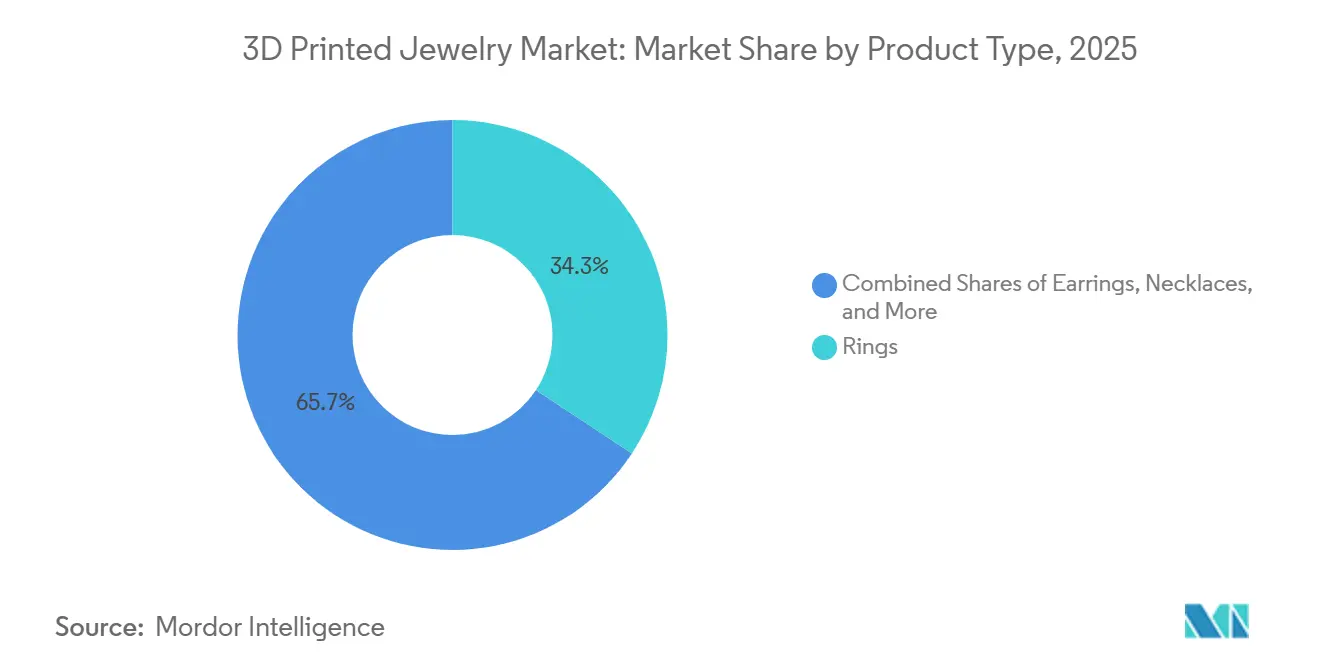
Rings Anchor Revenue While Necklaces Lead GrowthRings accounted for 34.29% of 3D printed jewelry market share in 2025, the largest share among product types. Engagement rings, wedding bands, and signet rings are well suited to a process that requires repeated design review. A jeweler can print a resin model, confirm fit, refine the form, and then prepare the design for casting. This sequence fits the consultation process used for many high-value ring purchases. The 3D printed jewelry market helps reduce wasted metal during early revisions because fit and geometry can be resolved before final production. It also allows individual clients to request changes without requiring new hard tooling.
Necklaces are projected to grow at a CAGR of 13.47% through 2031. Their growth reflects the design freedom available for chain links, pendants, and complex connected forms. Some interlocked structures are difficult to hand-fabricate or expensive to make with CNC processes. Additive production allows these structures to be prepared within a single build when the design and production method are compatible. Earrings continue to offer steady demand, including lightweight lattice designs that can reduce precious metal content. Bracelets, chains, and pendants provide volume for casting houses that are moving from carved wax patterns to printed masters. Formlabs notes that overnight multi-product runs are used by mid-volume studios, which can broaden the range of products produced on the same equipment.



By Material:
Resins Sustain Dominance While Mixed Materials Gain TractionResins held 48.26% of revenue in 2025. Their position reflects the established use of SLA and DLP patterns in conventional investment casting workflows. Many jewelers already understand how to cast from a high-quality printed pattern. Formlabs released True Cast Resin for the Form 4 series in 2025. The company describes it as a wax-filled photopolymer for casting patterns up to 5 mm thick with clean burnout and no measurable ash residue under clean-burn conditions. This material approach supports casting quality and can reduce problems that lead to extra finishing work.
Mixed materials are forecast to grow at a CAGR of 13.55% between 2026 and 2031. The category gains interest where a process combines resin binders with metal powder or ceramic components. Legor and Tritone announced a partnership in June 2026 around Tritone’s MoldJet process for gold and platinum production. The process uses an encapsulated paste format instead of free metal powder handling. Wax remains useful because it burns out cleanly and fits established casting trees. Its higher material cost and mechanical fragility, however, continue to limit use to professional production settings.
By Consumer Group:
Women Drive Volume While Unisex Expands the Opportunity SetWomen accounted for 56.48% of revenue in 2025. Demand was concentrated in engagement rings, personalized pendants, and statement necklaces. These categories often involve high design iteration, which gives the consultation process a clear purpose. Design tools that help nontechnical users discuss a customization can make this process more accessible. The 3D printed jewelry market gives designers a way to adjust a model without restarting a physical production process. This can support buyer participation in decisions about fit, ornament, and personal details.
Unisex jewelry is forecast to grow at a CAGR of 13.78% through 2031. Gen Z and Millennial buyers are seeking designs that are based on personal style rather than traditional gender categories. This requires design libraries that focus on form and aesthetic preference. Additive manufacturing can support that approach because new variations can be created without retooling each form. Men’s jewelry also records steady demand for signet rings, ID bracelets, and chains. Children’s jewelry remains a smaller category that is largely linked to gifts and commemorative purchases. Its lower level of personalization limits its near-term contribution relative to the other consumer groups.
By Distribution Channel:
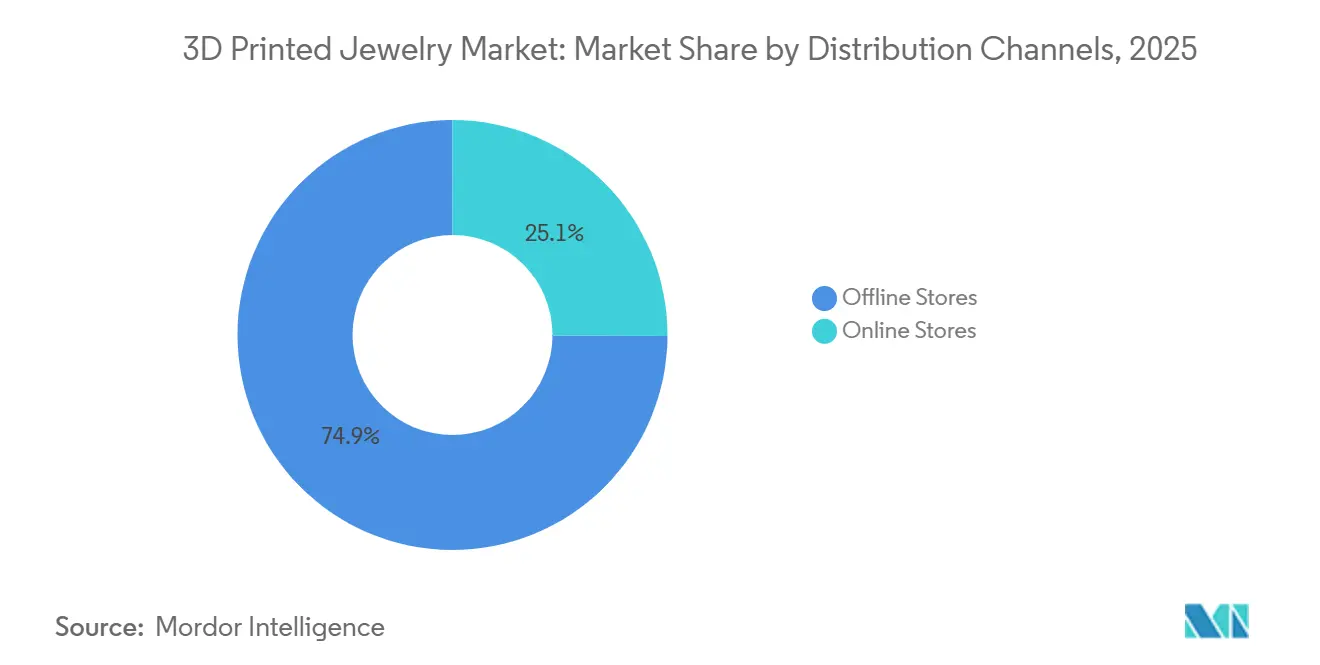
Offline Commands Share While Online Rewrites the Growth CurveOffline stores held 75.68% of revenue in 2025. High-value custom purchases often still depend on in-person consultations and physical review. A printed prototype can help a buyer assess scale, comfort, and design details before final casting. This makes an offline setting useful even when the initial design is created online. The 3D printed jewelry market allows store staff to use physical samples as part of the selling process. The channel can remain important because trust, fit, and personal guidance are significant in custom jewelry transactions.
Online stores are projected to grow at a CAGR of 14.21% through 2031. A direct-to-consumer configurator can show a customized design and send the approved file to a production site. This connects order intake with manufacturing without requiring inventory for every possible configuration. The 3D printed jewelry market can combine online design access with store-based delivery or consultation. Formlabs reports that printed models are used in jewelry workflows to review designs before precious metal is used. A hybrid model can therefore use online tools for discovery and design while retaining an in-person step for review, payment, or collection. This arrangement reduces the separation between digital demand generation and traditional jewelry retail.
Geography Analysis
North America 3D Printed Jewelry Market
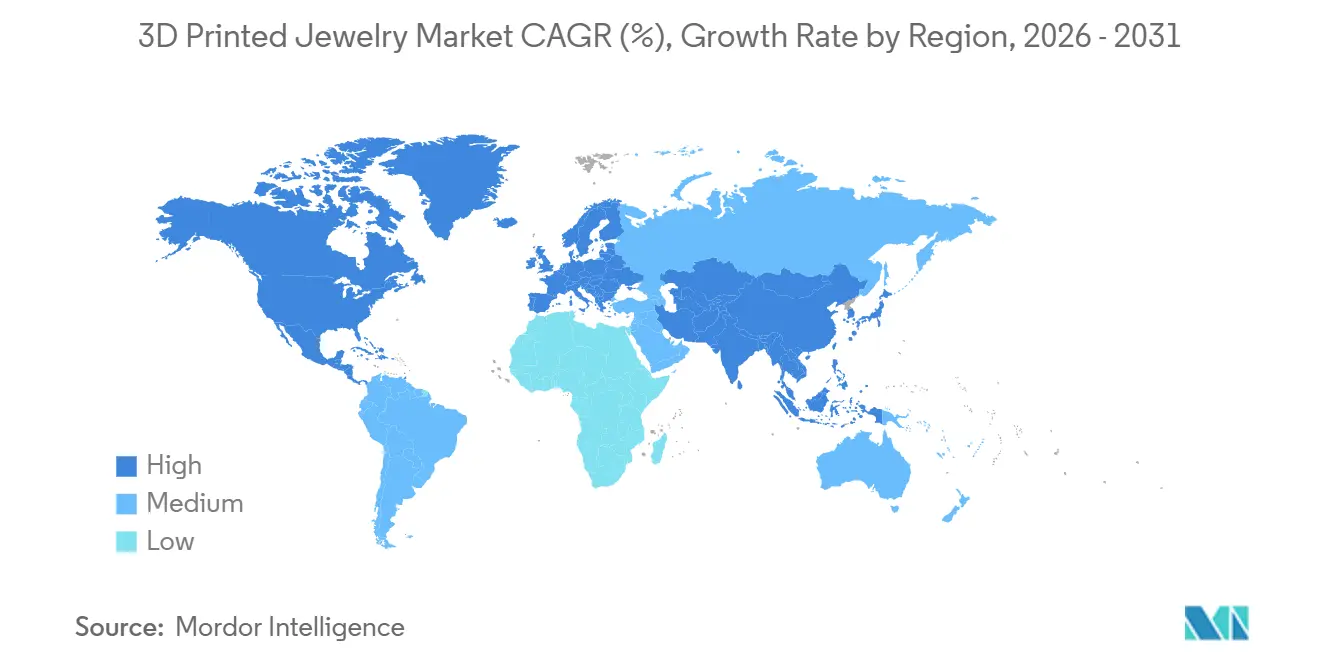
North America held 41.29% of the 3D printed jewelry market share in 2025. The region benefits from concentrations of independent designers, established digital commerce infrastructure, and access to suppliers such as Formlabs, B9Creations, and Solidscape. California and New York remain important design centers for custom work. The U.S. regulatory framework for metal disclosure and hallmarking provides a more standardized operating environment than many fragmented certification systems. This can reduce compliance friction for domestic producers. Canada supports adoption through CAD-to-print education activities, while Mexico is developing as a value-added production location for North American supply chains.
Europe 3D Printed Jewelry Market
Europe has a major role in equipment, alloy, and jewelry manufacturing expertise. Italy’s Vicenza-Bressanvido area includes DWS Systems, SISMA, Legor Group, and Progold. This group of companies links hardware, precious-metal alloys, and additive production knowledge within a specialized jewelry cluster. Germany, France, and the UK add demand for premium jewelry and technical manufacturing services. European material suppliers also face incentives to improve traceability and purity documentation under REACH requirements.
APAC, Middle East and South America 3D Printed Jewelry Market
Asia-Pacific is forecast to expand at a CAGR of 13.87% between 2026 and 2031. India’s hallmarking requirements create demand for production systems that support consistent purity records and traceability[3]Source: Bureau of Indian Standards, “Jewellers Hallmarking,” Bureau of Indian Standards, bis.gov.in. Vietnam, Indonesia, and Thailand provide cost-effective manufacturing capacity. Australia and Singapore contribute premium consumer demand, while the UAE, Saudi Arabia, Brazil, and Argentina remain commercially active emerging markets.

Competitive Landscape
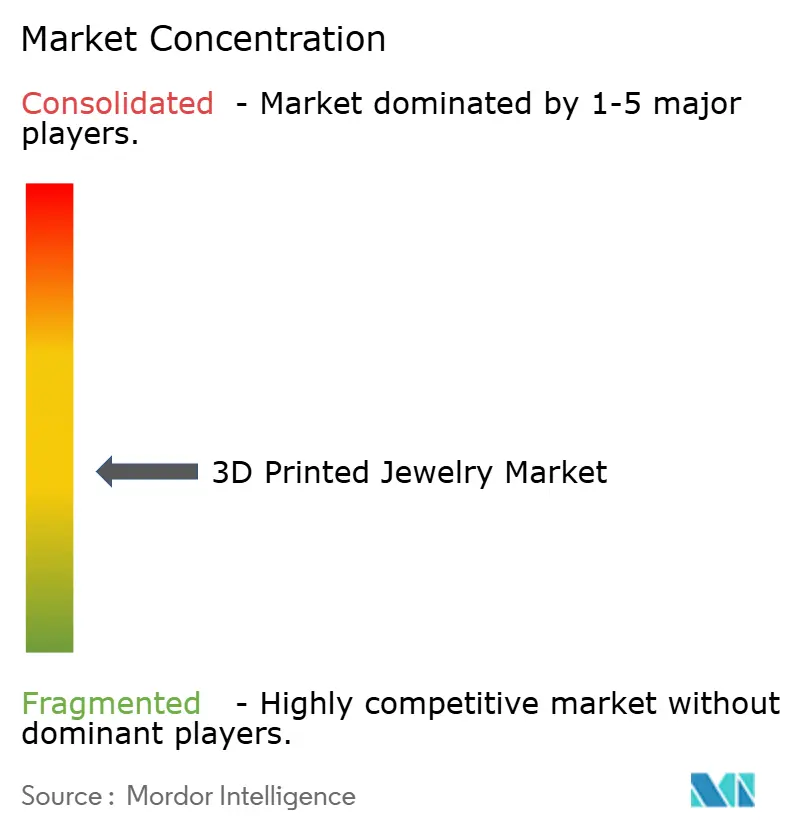
The 3D printed jewelry market is moderately fragmented. Competition is spread across hardware suppliers, material providers, specialist production firms, and finished-product brands. No 1 company controls both the equipment layer and the finished jewelry layer. Hardware firms compete on resolution, throughput, and compatibility with casting processes. Material suppliers compete on alloy formulations, burnout performance, and process reliability. This structure leaves room for specialized firms that serve a specific part of the production chain.
Formlabs has expanded its castable resin offering for jewelry-related casting needs. Its 2025 True Cast Resin release focused on detailed patterns and clean burnout for the Form 4 platform. Legor and Tritone formed a June 2026 partnership to integrate MoldJet technology into Legor’s 3D Metal Hub. The arrangement extends direct printing capabilities for gold and platinum across high jewelry, watchmaking, and luxury accessories. EOS demonstrated AI-driven adaptive process controls at Hannover Messe in April 2026. These moves show that suppliers are competing through materials, process control, and easier production workflows.
New software providers are targeting the design bottleneck rather than only printer performance. Print-ready files can lower the time and expertise required to prepare customized designs. Established equipment suppliers are responding with automation that reduces dependence on skilled operators at particular stages. Incus introduced the Hammer Pro25 in October 2025 with features aimed at industrial precision metal production. The 3D printed jewelry market favors companies that can connect certified materials, design validation, printing, and cast-ready output. Provenance and documentation will become more important as hallmarking and cross-border compliance requirements become stricter. The concentration score remains 4 out of 10 because the available evidence shows a fragmented field without a dominant integrated supplier.
3D Printed Jewelry Industry Leaders
Materialise NV
Stratasys Ltd.
EOS GmbH
Formlabs
Prodways Group
- *Disclaimer: Major Players sorted in no particular order
3D Printed Jewelry Market Companies Covered in this Report
- 3D Systems
- Formlabs
- Materialise NV
- Stratasys Ltd.
- Desktop Metal
- HP Inc.
- EOS GmbH
- DWS Systems
- Solidscape
- Asiga
- B9Creations LLC
- Incus GmbH
- Legor Group S.p.A.
- SISMA S.p.A.
- Shapeways, Inc.
- Prodways Group
- Imaginarium
- MIRAKIN
- OLA Jewelry
- NERVOUS SYSTEM, INC.
- RADIAN Jewelry
- Platinum Guild International

Recent Industry Developments in 3D Printed Jewelry Market
- June 2026: Legor Group S.p.A. and Tritone Technologies announced a strategic partnership to integrate Tritone’s patented MoldJet technology into Legor’s 3D Metal Hub. The arrangement enables direct 3D printing in gold and platinum for high jewelry, watchmaking, and luxury accessories.
- June 2025: Platinum Guild International (PGI) unveiled Tùsaire, the world's first commercially available 3D-printed platinum jewellery collection, created by designer Maeve Gillies using advanced laser powder bed fusion technology in collaboration with ProGold.
- June 2025: Formlabs released True Cast Resin for the Form 4 series, a wax-filled photopolymer formulated for clean burnout of intricate jewelry investment casting patterns up to 5 mm thick, with zero ash residue in clean-burn conditions. The material was developed in response to production jeweler feedback on Castable Wax and Castable Wax 40 Resin and extends the Form 4 platform into professional casting workflows


Global 3D Printed Jewelry Market Report Scope
| Rings |
| Necklaces |
| Earrings |
| Bracelets |
| Chains and Pendants |
| Others |
| Raisins |
| Wax |
| Mixed Materials |
| Men |
| Women |
| Unisex |
| Children |
| Offline Stores |
| Online Stores |
| North America | United States |
| Canada | |
| Mexico | |
| Rest of North America | |
| Europe | Germany |
| United Kingdom | |
| France | |
| Italy | |
| Spain | |
| Netherlands | |
| Sweden | |
| Poland | |
| Belgium | |
| Rest of Europe | |
| Asia-Pacific | China |
| India | |
| Japan | |
| Australia | |
| South Korea | |
| Vietnam | |
| Indonesia | |
| Thailand | |
| Singapore | |
| Rest of Asia-Pacific | |
| South America | Brazil |
| Argentina | |
| Chile | |
| Peru | |
| Colombia | |
| Rest of South America | |
| Middle East and Africa | United Arab Emirates |
| Saudi Arabia | |
| South Africa | |
| Nigeria | |
| Egypt | |
| Morocco | |
| Turkey | |
| Rest of Middle East and Africa |
| By Product Type | Rings | |
| Necklaces | ||
| Earrings | ||
| Bracelets | ||
| Chains and Pendants | ||
| Others | ||
| By Material | Raisins | |
| Wax | ||
| Mixed Materials | ||
| By Consumer Group | Men | |
| Women | ||
| Unisex | ||
| Children | ||
| By Distribution Channels | Offline Stores | |
| Online Stores | ||
| By Geography | North America | United States |
| Canada | ||
| Mexico | ||
| Rest of North America | ||
| Europe | Germany | |
| United Kingdom | ||
| France | ||
| Italy | ||
| Spain | ||
| Netherlands | ||
| Sweden | ||
| Poland | ||
| Belgium | ||
| Rest of Europe | ||
| Asia-Pacific | China | |
| India | ||
| Japan | ||
| Australia | ||
| South Korea | ||
| Vietnam | ||
| Indonesia | ||
| Thailand | ||
| Singapore | ||
| Rest of Asia-Pacific | ||
| South America | Brazil | |
| Argentina | ||
| Chile | ||
| Peru | ||
| Colombia | ||
| Rest of South America | ||
| Middle East and Africa | United Arab Emirates | |
| Saudi Arabia | ||
| South Africa | ||
| Nigeria | ||
| Egypt | ||
| Morocco | ||
| Turkey | ||
| Rest of Middle East and Africa | ||


Key Questions Answered in the Report
How Big is 3D Printed Jewelry Market?
The 3D printed jewelry market size was valued at USD 0.87 billion in 2025 and estimated to grow from USD 0.98 billion in 2026 to reach USD 2.03 billion by 2031, at a CAGR of 12.33%.
Which 3D printed jewelry product category has the largest share?
Rings led product types with 34.29% share in 2025, supported by demand for engagement rings, wedding bands, and signet rings.
Which material is used most widely in 3D printed jewelry?
Resins held 48.26% share in 2025 because they work well with established SLA, DLP, and investment casting workflows.
Why are online stores growing in this sector?
Online stores are forecast to grow at a CAGR of 14.21% through 2031 because configurators can connect customized designs directly to production.
Page last updated on:


 Your data is secure and never sold or shared.


