
3D Generative AI Platforms For XR Content Creation Market Size and Share
Market Overview
| Study Period | 2020 - 2031 |
|---|---|
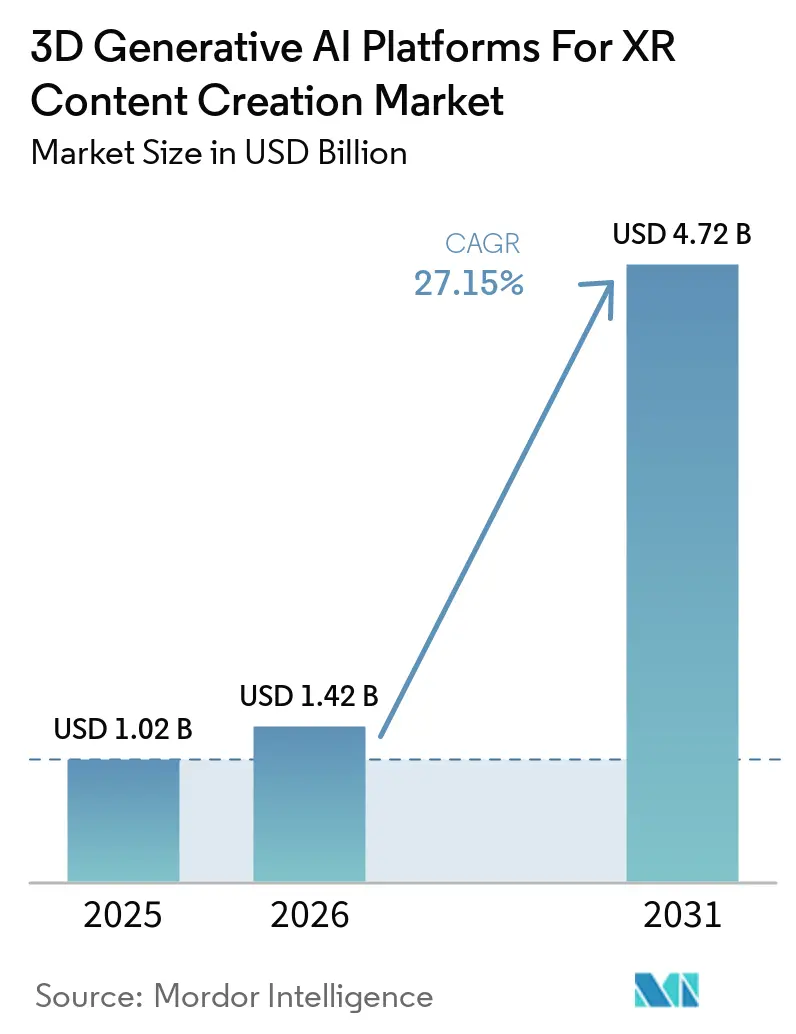
| Market Size (2026) | USD 1.42 Billion |
| Market Size (2031) | USD 4.72 Billion |
| Growth Rate (2026 - 2031) | 27.15 % |
| Fastest Growing Market | Asia-Pacific |
| Largest Market | North America |
| Market Concentration | Medium |
Major Players *Disclaimer: Major Players sorted in no particular order Image © Mordor Intelligence. Reuse requires attribution under CC BY 4.0. | |
3D Generative AI Platforms For XR Content Creation Market Analysis by Mordor Intelligence
The 3D generative AI platforms for XR content creation market size is projected to expand from USD 1.02 billion in 2025 and USD 1.42 billion in 2026 to USD 4.72 billion by 2031, registering a CAGR of 27.15% between 2026 to 2031. The 3D generative AI platforms for XR content creation market is shaped by faster 3D generation models and a larger base of XR devices that need new content. Platforms are moving beyond single assets toward connected workflows that create scenes, materials, and usable outputs for game engines. Enterprise demand is broadening from creative teams to simulation, training, product visualization, and commerce operations. Companies are seeking systems that lower production time while retaining the quality, control, and format compatibility needed for commercial use. Copyright provenance, geometry reliability, and the cost of detailed animated scenes continue to affect procurement decisions in the 3D generative AI platforms for XR content creation market.
Key Report Takeaways
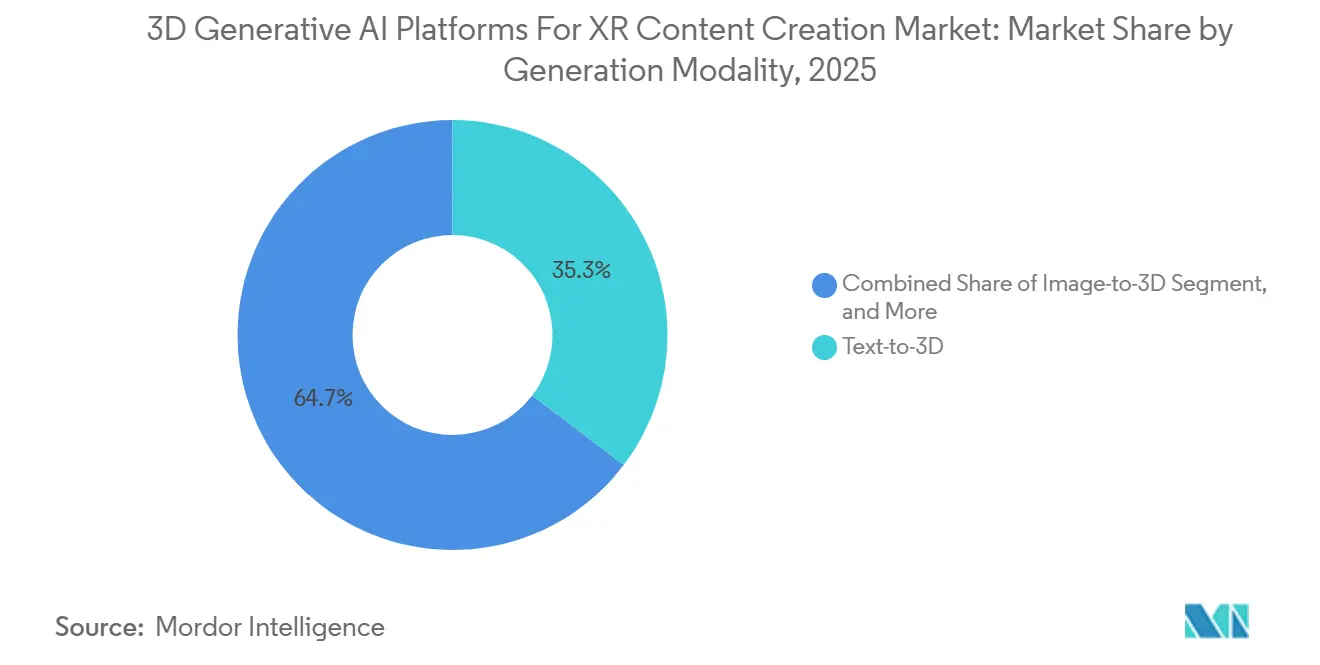
- By generation modality, Text-to-3D held 35.34% of the 3D generative AI platforms for XR content creation market share in 2025, while Multi-Input and Reference-Guided Generation is projected to expand at a CAGR of 28.22% through 2031.
- By platform capability, Asset Generators held 30.35% in 2025, while Scene and World Generators are projected to expand at a CAGR of 28.45% through 2031.
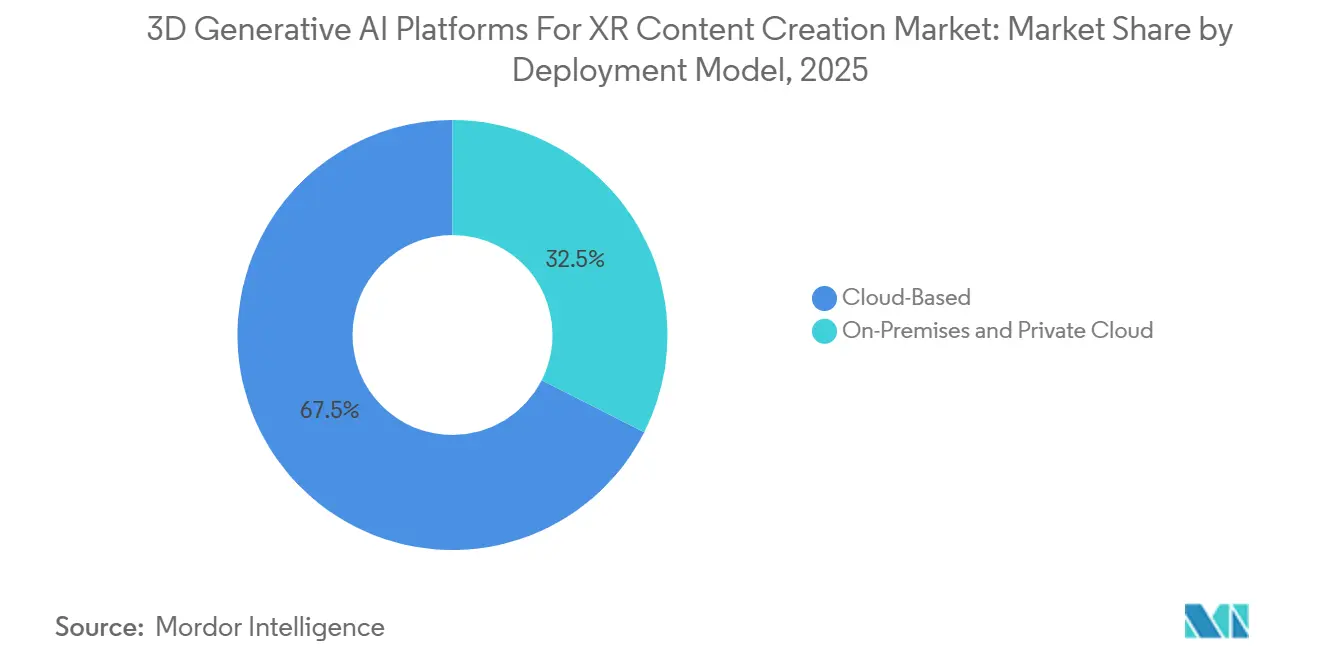
- By deployment model, Cloud-Based deployment held 67.54% in 2025 and is projected to expand at a CAGR of 28.78% through 2031in the 3D generative AI platforms for XR content creation market.
- By application, Game Development held 32.38% in 2025, while Simulation, Training, and Digital Twins is projected to expand at a CAGR of 28.97% through 2031 in the 3D generative AI platforms for XR content creation market.
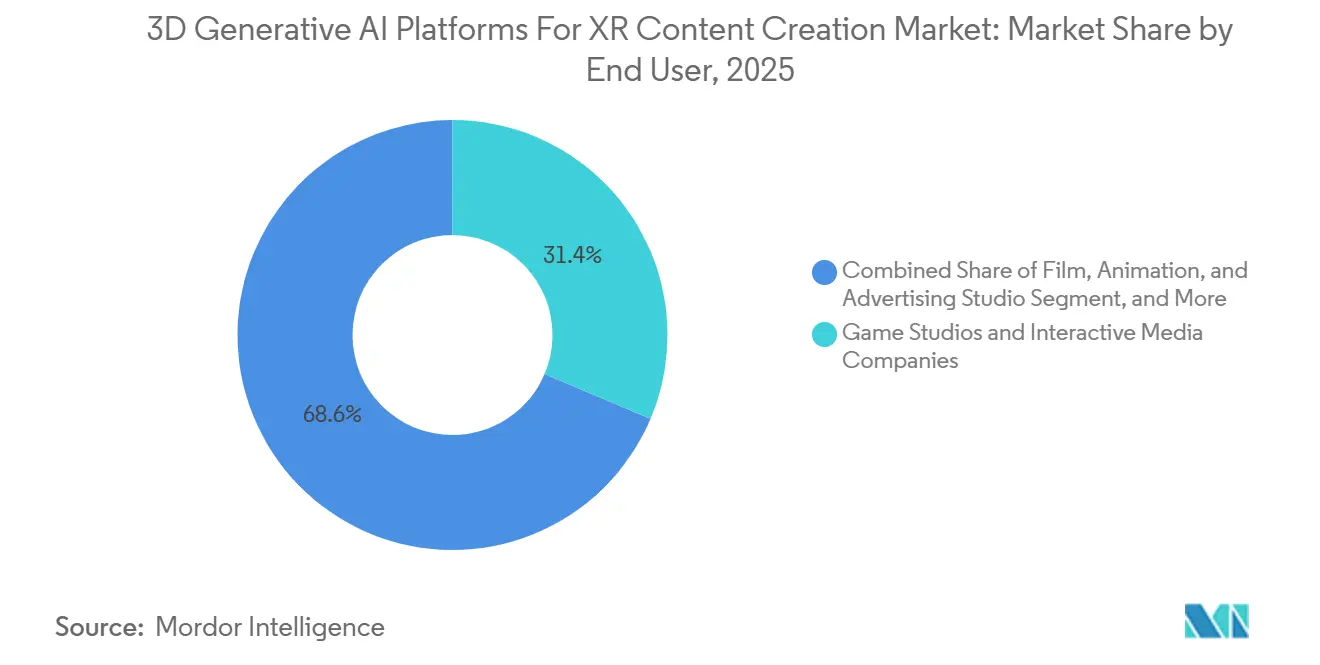
- By end user, Game Studios and Interactive Media Companies held 31.37% in 2025, while Technology Companies and XR Platform Developers are projected to expand at a CAGR of 28.54% through 2031.
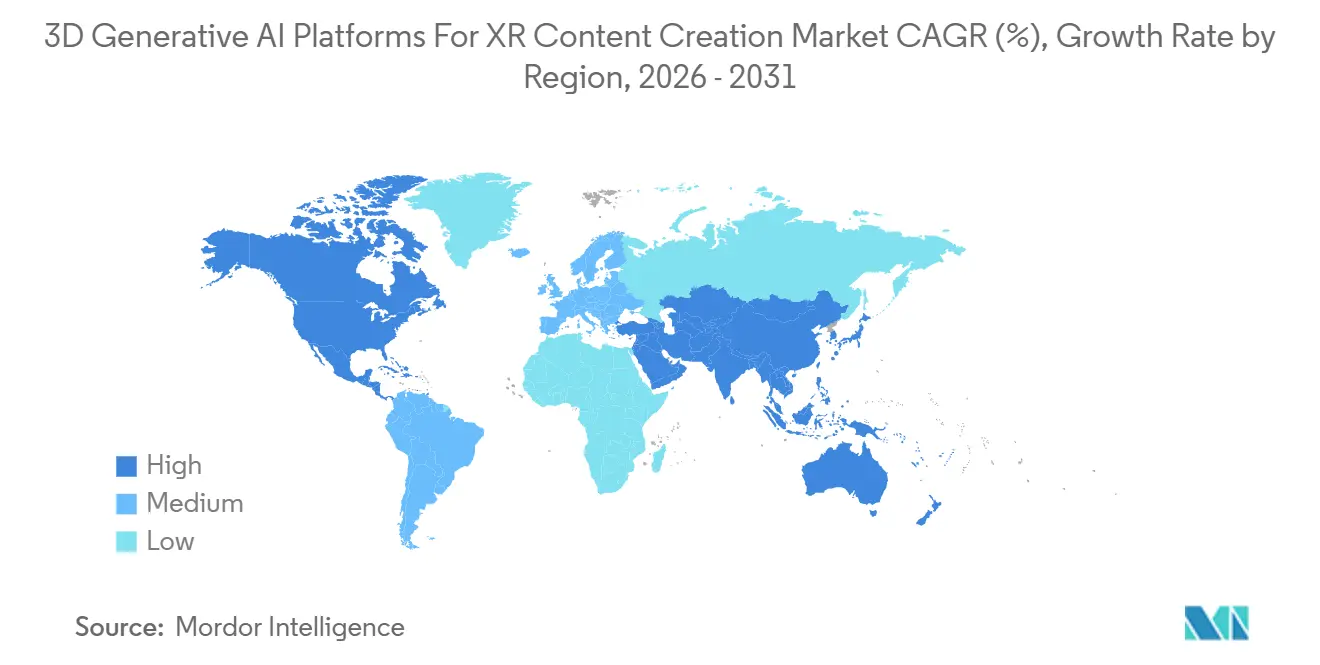
- By geography, North America held 34.40% in 2025, while Asia-Pacific is projected to expand at a CAGR of 28.46% through 2031.
Note: Market size and forecast figures in this report are generated using Mordor Intelligence’s proprietary estimation framework, updated with the latest available data and insights as of January 2026.
Market Trends and Insights
Drivers Impact Analysis of 3D Generative AI Platforms For XR Content Creation Market*
| Driver | (~) % Impact on CAGR Forecast | Geographic Relevance | Impact Timeline |
|---|---|---|---|
| Falling Cost of Production-Ready 3D Asset Generation | +5.2% | Global, led by North America and East Asia | Short term (≤ 2 years) |
| Expansion of XR Device and WebXR Distribution Channels | +4.8% | Global, led by North America and Asia-Pacific, with Europe and the Middle East as secondary markets | Short term (≤ 2 years) |
| Demand for Game-Ready and Simulation-Ready Synthetic Worlds | +4.1% | North America, China, South Korea, and Japan | Medium term (2-4 years) |
| Enterprise Need for Faster Product Visualization and Commerce Content | +3.5% | North America, Europe, and Asia-Pacific retail markets | Medium term (2-4 years) |
| Conversational Creation Reducing the 3D Skills Barrier | +3.0% | Global, with South America, the Middle East, and Africa benefiting from lower skill barriers | Medium term (2-4 years) |
| Model-Context-Aware Workflows Connecting AI to 3D Software and Game Engines | +2.8% | North America and Europe, expanding to Asia-Pacific | Long term (≥ 4 years) |
| Source: Mordor Intelligence | |||
Falling Cost of Production-Ready 3D Asset Generation
GPU compute pricing and inference optimization have lowered the cost of producing 3D assets at volume. This makes batch creation more practical for teams outside the largest game studios. Roblox reduced full-object generation time for its Cube 3D foundation model by 87%, from 31 seconds to 4 seconds, using CUDA Graphs and KV caching on NVIDIA H100 GPUs.[1] Faster generation changes the economics of asset production because teams can test more variations during a project. The 3D generative AI platforms for XR content creation market benefits when platforms can deliver usable assets without a long rendering queue. It also puts pressure on outsourced production models that depend on lower labor costs and long asset handoffs.
Expansion of XR Device and WebXR Distribution Chan
A larger XR device base increases the number of places where 3D content can be used. Smart glasses are becoming a more important part of device demand, which raises demand for lightweight assets that work without heavy local processing. The expanding device base makes distribution formats and runtime compatibility more important for the 3D generative AI platforms for XR content creation market. WebXR also provides a browser route for content delivery, reducing the dependence on app-store distribution. The W3C WebXR Device API and Khronos Group OpenXR standards remain active areas of interoperability work under Interop 2026. Better cross-browser and cross-device support can reduce rework for content teams. This supports platforms that produce assets suited to different XR endpoints without rebuilding the same scene for each channel.
Demand for Game-Ready and Simulation-Ready Synthetic Worlds
Game studios and simulation operators increasingly need complete, navigable environments rather than separate 3D props. WorldGen, presented at CVPR 2026, generates traversable 3D worlds from a text prompt and decomposes outputs into individual meshes compatible with game engines. NVIDIA published CTRL-G in July 2026 to address controllable generative graphics within game engines. PepsiCo reported that digital-twin pilots identified up to 90% of facility issues before physical modifications and improved throughput by 20%.[2]These use cases place more value on spatial consistency and usable geometry than on an isolated asset's visual quality. The 3D generative AI platforms for XR content creation market therefore favors vendors able to sustain context across multiple generation steps.
Enterprise Need for Faster Product Visualization and Commerce Content
Product visualization is becoming part of regular commerce operations rather than a separate creative service. Zalando and Allsides scaled their 3D digital-twin pipeline to 10,000 footwear SKUs in 2025 and target 45,000 SKUs in 2026.[3] LG Electronics said its RetailVerse automation reduced 3D model development from weeks to less than 1 day per model. Google has applied its Veo model to interactive 3D product views for furniture, apparel, and electronics across Google Shopping. Large catalog contracts can provide repeat demand for the 3D generative AI platforms for XR content creation market. They also reward vendors that can manage version control, product fidelity, and fast updates across retailer sites.
Restraints Impact Analysis of 3D Generative AI Platforms For XR Content Creation Market*
| Restraint | (~) % Impact on CAGR Forecast | Geographic Relevance | Impact Timeline |
|---|---|---|---|
| Inconsistent Geometry, Topology, and Physical Plausibility | -2.2% | Global, most acute in enterprise and game-engine workflows | Short term (≤ 2 years) |
| Copyright, Training-Data Provenance, and Commercial Usage Uncertainty | -1.8% | North America and Europe, where litigation and regulation are most active | Medium term (2-4 years) |
| High Inference Cost for Animated, Interactive, and High-Fidelity Scenes | -1.3% | Global, with greater impact in Asia-Pacific and South America | Medium term (2-4 years) |
| Fragmented Export Standards and Weak Interoperability Across XR Stacks | -0.9% | Global, most acute in multi-device enterprise deployments | Long term (≥ 4 years) |
| Source: Mordor Intelligence | |||
Inconsistent Geometry, Topology, and Physical Plausibility
Mesh quality remains a direct barrier for enterprise projects that require simulation, collision detection, or animation. Eval3D showed that AI-generated 3D assets can appear convincing but still contain surface-normal inconsistencies that affect downstream work. Text-to-3D systems can produce multi-face artifacts when their two-dimensional priors do not agree across views. Image-to-3D systems must also infer back-side geometry that the source image does not show. These issues add manual retopology work and reduce some of the time savings promised by the 3D generative AI platforms for XR content creation market. Native 3D diffusion systems that generate topology-aware meshes directly are intended to reduce these quality gaps.
Copyright, Training-Data Provenance, and Commercial Usage Uncertainty
Legal uncertainty affects projects involving branded characters, licensed games, and other content with strict rights requirements. The United States Copyright Office stated that generative AI training questions remain contested across the United States, the United Kingdom, the European Union, China, and Japan. The United Kingdom's Data (Use and Access) Act 2025 created transparency obligations for AI systems trained on copyrighted works. Academic analysis in JIPITEC identified copyright questions around reproductions within model weights under European Union law. Buyers may resist platforms that cannot document the origin and permitted use of training material. Provenance, indemnification, and documentation are therefore important commercial requirements in the 3D generative AI platforms for XR content creation market.
*Our forecasts treat driver/restraint impacts as directional, not additive. The impact forecasts reflect baseline growth, mix effects, and variable interactions.
3D Generative AI Platforms For XR Content Creation Market Segment Analysis
By Generation Modality:
Text-to-3D Holds the Largest Position, While Multi-Input Workflows Gain TractionText-to-3D held 35.34% of the 3D generative AI platforms for XR content creation market share in 2025. Its position reflects the ease with which non-specialist users can describe an object without preparing reference assets. Text-conditioned diffusion pipelines also have a more established user workflow than newer multimodal tools. Progressive Rendering Distillation research at CVPR 2025 demonstrated sub-second text-to-mesh latency on H20 GPU hardware through a 4-step generation process. The result suggests that quality and latency constraints are being addressed through model architecture and optimization. Text-to-3D remains useful for early concepts, props, and rapid iteration. It is less reliable when a project requires exact brand details, fixed geometry, or repeatable scene context.
Multi-Input and Reference-Guided Generation is projected to expand at a CAGR of 28.22% through 2031. This modality accepts text, images, and video references at the same time, giving enterprise users more ways to define a required output. Reference-guided workflows are useful where a generated asset must remain consistent with existing product images or brand materials. Tripo integrated GPT Image 2 in April 2026 for text-to-image-to-3D workflows. This reflects a broader shift toward systems that route a task through more than 1 model. The architecture can raise switching costs because the workflow, not only the underlying model, becomes embedded in a team's process. Image-to-3D and Video-to-3D remain complementary paths for product digitization and volumetric reconstruction. The 3D generative AI platforms for XR content creation industry is therefore moving toward input flexibility rather than a single preferred prompt type.

By Platform Capability:
Asset Generators Support Volume, While Scene and World Generators Lead ExpansionAsset Generators held 30.35% of the platform capability segment in 2025. Their position comes from ongoing demand for individual props across game development, e-commerce, and marketing work. Game studios use these tools to speed up early asset creation and content variations. E-commerce teams use them to build product visualizations at larger catalog scale. Character and Avatar Generators meet a separate need in social XR, gaming, and enterprise training. These tools require human-readable digital representation and stronger anatomical control than general object generators. Animation, Rigging, and Motion Generators also support teams seeking to reduce the cost of animation derived from reference video.
Scene and World Generators are projected to expand at a CAGR of 28.45% through 2031. Their growth reflects the move from buying separate assets to creating connected environments. Tencent open-sourced HY-World 2.0 in April 2026, describing a multimodal world model that accepts text, image, and video inputs and exports game-ready assets into Unity and Unreal Engine workflows. AIST reported the publication of ISO/IEC 24216-1:2026 in June 2026, which establishes terminology and compliance criteria for XR avatars. Shared terminology and compliance criteria can help character, avatar, and animation vendors serve multi-device deployments. The 3D generative AI platforms for XR content creation market size for environment-level work is supported by buyers that need semantic consistency over many generation passes. Scene generators are most useful when a single project needs navigable space, not only visual assets.
By Deployment Model:
Cloud-Based Deployment Retains Its Lead, While Private Environments Address Control RequirementsCloud-Based deployment accounted for 67.54% of the deployment model segment in 2025. It is also projected to expand at a CAGR of 28.78% through 2031. Browser-based platforms can coordinate several models and give customers access without local infrastructure setup. This model is useful where teams need flexible capacity for high-volume generation. It also allows providers to update the model stack and add new formats centrally. Competitive GPU cloud pricing and inference optimization continue to support the cloud model. The 3D generative AI platforms for XR content creation market benefits from this option because smaller studios can access advanced capabilities without owning dedicated hardware.
On-Premises and Private Cloud deployment is gaining use where data sovereignty, intellectual property control, or low latency are more important than deployment cost. Defense, aerospace, and pharmaceutical simulation operators are among the users with these requirements. These organizations may need to keep proprietary designs inside controlled environments. Siemens launched Digital Twin Composer at CES 2026 through the Siemens Xcelerator marketplace, with private-cloud configurations for customers managing proprietary design data. European enterprise buyers may also consider documentation and system controls under the European Union AI Act. Private deployments do not replace cloud delivery for most users, but they give providers a route into regulated and sensitive applications. The model split shows that deployment choice is tied to the nature of the content and the user's governance needs.
By Application:
Game Development Leads Demand, While Simulation, Training, and Digital Twins Advance FasterGame Development held 32.38% of the application segment in 2025. Studios face larger game worlds and continued pressure to deliver content without matching increases in headcount. Generative asset pipelines can help teams close part of this content gap. Tripo's DCC Bridge added UE 5.8 support in June 2026, enabling generated models to arrive in scenes with physics-based rendering materials already assigned. The AutoUE research presented at ACL 2026 described a multi-agent system for producing 3D games in Unreal Engine from natural-language inputs. Such developments place generative systems closer to the production toolchain. The 3D generative AI platforms for XR content creation market is supported when outputs can be imported and adjusted inside familiar game-engine workflows.
Simulation, Training, and Digital Twins is projected to expand at a CAGR of 28.97% through 2031. Enterprise and government operators use physically accurate synthetic environments for training, testing, and facility planning. Siemens introduced Simcenter PhysicsAI Generate in its summer 2026 release for design concept generation using physics-aware generative AI. This application needs more than attractive visual output because the environment must support relevant physical behavior. Virtual Reality and Augmented Reality Experiences and Film, Animation, and Cinematics continue to benefit from content platform growth and AI-assisted retopology and texturing. Product Visualization, E-Commerce, and Marketing is also gaining from documented enterprise use cases. These references can shorten sales discussions for vendors pursuing retail customers. The 3D generative AI platforms for XR content creation market size is most closely tied to applications that turn generated content into a recurring operational input.
By End User:
Game Studios Lead Usage, While Technology Companies and XR Platform Developers Expand FasterGame Studios and Interactive Media Companies held 31.37% of the end-user segment in 2025. This group includes large publishers using enterprise application programming interfaces and smaller developers using subscription tools. The range of users shows that adoption is not limited to companies with dedicated pipeline engineering teams. Film, Animation, and Advertising Studios form the next major group, using AI retopology and texturing to reduce post-production work. These users retain specialized creative needs but can use generative systems for repetitive preparation tasks. Game studios also provide a practical test environment for engine compatibility and asset reliability. Their continued demand keeps the 3D generative AI platforms for XR content creation market closely connected to the quality of production-ready outputs.
Technology Companies and XR Platform Developers are projected to expand at a CAGR of 28.54% through 2031. These users treat 3D generation as an infrastructure capability that can be embedded into a broader platform. Unity's official MCP server for AI tools is in beta and aims to connect AI systems with game-development workflows. MCP integrations for Blender, Godot, and Unreal Engine can reduce the gap between a generated object and its use within a development environment. Manufacturing, Retail, and Consumer Brands are also expanding their use of catalog digitization and augmented-reality commerce. Healthcare simulation operators, educational institutions, and government agencies remain earlier-stage users with room for medium-term adoption. The 3D generative AI platforms for XR content creation industry can serve these groups when providers combine content generation with security, integration, and workflow controls.
Geography Analysis
North America 3D Generative AI Platforms for XR Content Creation Market
North America held 34.40% of the 3D generative AI platforms for XR content creation market share in 2025. The region combines game studios, XR hardware development, venture-backed generative AI companies, and enterprise buyers. The United States supports demand through both procurement and startup formation. Meshy reported USD 30 million in annual recurring revenue and 10 million users in March 2026. Tripo AI announced a USD 50 million funding round in March 2026 to support 3D foundation model research and international expansion. Canada contributes through visual effects and animation activity. The United States Copyright Office's continuing review of AI training issues adds planning requirements for platforms selling to rights-sensitive customers.
APAC 3D Generative AI Platforms for XR Content Creation Market
Asia-Pacific is projected to expand at a CAGR of 28.46% through 2031. China, Japan, South Korea, and India each contribute different sources of demand. China's open-source ecosystem supports rapid experimentation with world models and developer tools. Japan's enterprise adoption is linked to spatial capture and production workflows. Sony launched XYN Spatial Scan for enterprises in Japan in April 2026 to convert real-world spaces into photorealistic 3DCG assets for XR workflows. KDDI Research reported a 5× improvement in 3D Gaussian Splatting model generation from video in June 2026. The 3D generative AI platforms for XR content creation market in the region also benefits from standards that help content move across a fragmented hardware environment.
EMEA and South America 3D Generative AI Platforms for XR Content Creation Market
Europe, South America, the Middle East, and Africa account for smaller but increasingly active demand areas. Europe's demand is linked to industrial simulation and automotive digital twins in Germany, games and visual effects in the United Kingdom, and luxury retail visualization in France. The European Union AI Act creates documentation work for platform vendors and may favor companies with established governance practices. Brazil leads early South American adoption, although cloud GPU gaps can raise inference costs. The United Arab Emirates and Saudi Arabia are investing in virtual production and XR infrastructure through national digitalization programs. South Africa is the main entry point in Africa, supported by a growing games and digital media sector. The 3D generative AI platforms for XR content creation market must adapt its delivery model to differences in local infrastructure, regulation, and buyer maturity.
Competitive Landscape
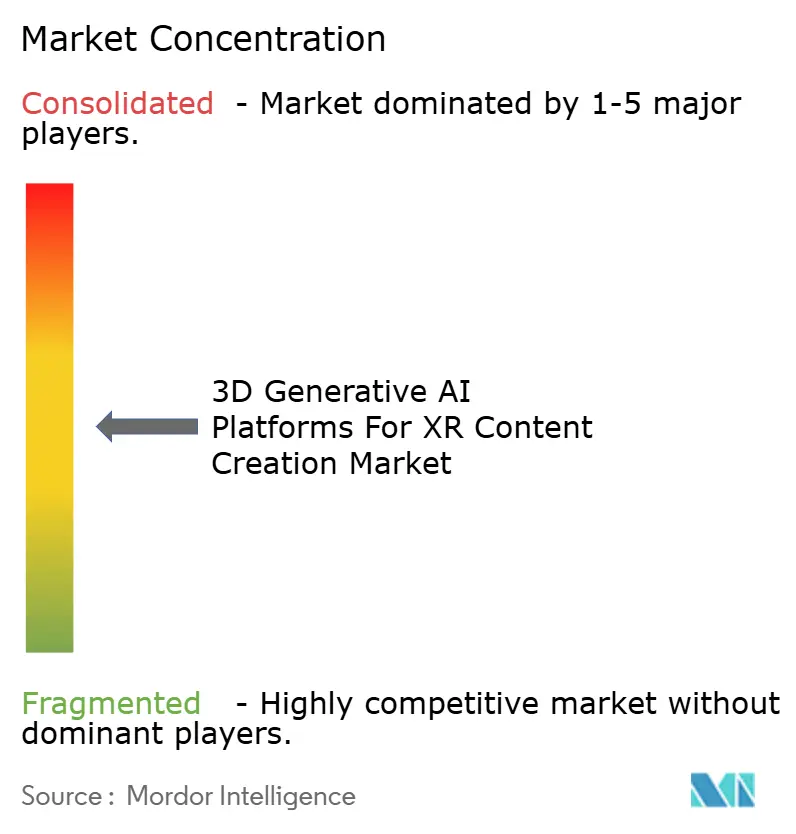
The 3D generative AI platforms for XR content creation market is moderately fragmented, with no single vendor holding a dominant global position. Specialized providers compete through model architecture, supported output formats, and depth of game-engine integration. Price is not the only basis of competition because buyers also assess whether generated content can move into their established tools. Pure-play platforms seek differentiation through faster generation, better geometry, and wider workflow coverage. Character and avatar providers hold more focused positions where animation readiness and body accuracy matter. The competitive field therefore includes broad asset platforms and specialized vendors serving defined production needs. The absence of a dominant company leaves room for both newer entrants and companies with strong ecosystem links.
MCP-based integration is becoming an important area of competition in the 3D generative AI platforms for XR content creation market. Unity's beta MCP server gives AI tools a route to interact with game-development workflows. Platforms that can work with Unity, Unreal Engine, Blender, and other tools can become embedded in daily production activity. This may reduce churn because users rely on the integration layer as well as the underlying generation model. Native 3D diffusion and geometry-first approaches are another area where providers seek defensible technical advantage. These approaches aim to avoid some issues caused when a 3D asset is produced through two-dimensional image priors. Vendor filings and product releases in this area can signal where future differentiation is forming.
China's open-source world-model ecosystem is shortening the time required for developers to access advanced capability. Tencent's launch of a global Hunyuan 3D engine illustrates how model availability can broaden the developer base. This creates a division between enterprise providers that offer integration, controls, and services, and asset-generation tools that face greater commoditization. Siemens' Digital Twin Composer illustrates a strategic move toward controlled enterprise configurations for proprietary design data. Sony's XYN Spatial Scan is another strategic move, linking enterprise spatial capture to 3DCG asset creation for XR use. The 3D generative AI platforms for XR content creation market will continue to reward vendors that connect content creation to a usable operating workflow.
3D Generative AI Platforms For XR Content Creation Industry Leaders
-
Meshy
-
Tripo Technology Co., Ltd.
-
Kaedim Ltd.
-
Alpha3D Technologies Inc.
-
Sloyd AS
- *Disclaimer: Major Players sorted in no particular order
3D Generative AI Platforms For XR Content Creation Market Companies Covered in this Report
- Meshy
- Tripo Technology Co., Ltd.
- Kaedim Ltd.
- Alpha3D Technologies Inc.
- Sloyd AS
- Masterpiece Studio Inc.
- Luma AI, Inc.
- Common Sense Machines, Inc.
- 3DFY.ai Ltd.
- Spline, Inc.
- Scenario AI, Inc.
- Hyper3D, Inc.
- Meshcapade GmbH
- Avaturn, Inc.
- in3D Ltd.
- DeepMotion, Inc.
- Rokoko Electronics ApS
- 3DAiLY, Inc.
- Kinetix SAS
- Kaiber, Inc.
Recent Industry Developments in 3D Generative AI Platforms For XR Content Creation Market
- July 2026: NVIDIA published the CTRL-G research initiative, presenting a framework for controllable generative graphics within game engines enabling real-time steering of generative models to align with player intent and production pipeline constraints.
- June 2026: KDDI Research in Japan published results for a 3D Gaussian Splatting model generation acceleration technology achieving 5× speed improvement from video inputs while maintaining output quality, targeting XR and spatial computing pipelines.
- April 2026: Tencent open-sourced HY-World 2.0, a multimodal 3D world model accepting text, image, and video inputs and exporting in Mesh, 3D Gaussian Splatting, and point-cloud formats with direct Unity and Unreal Engine integration.
- January 2026: PepsiCo announced a multi-year collaboration with Siemens and NVIDIA at CES 2026, applying physics-accurate 3D digital twins to plant and supply-chain simulation. United States pilots reported a 20% throughput improvement and up to 90% issue identification before physical modification.
Global 3D Generative AI Platforms For XR Content Creation Market Report Scope
The Global 3D Generative AI Platforms for XR Content Creation Market refers to the industry encompassing software platforms and cloud-based solutions that leverage generative artificial intelligence to create, modify, optimize, and automate the production of three-dimensional (3D) digital assets, environments, characters, animations, and interactive experiences for extended reality (XR) applications, including virtual reality (VR), augmented reality (AR), and mixed reality (MR).
The 3D Generative AI Platforms for XR Content Creation Market Report is Segmented by Generation Modality (Text-to-3D, Image-to-3D, Video-to-3D, and Multi-Input and Reference-Guided Generation), Platform Capability (Asset Generators, Character and Avatar Generators, Scene and World Generators, Animation, Rigging, and Motion Generators, and Other Platform Capabilities), Deployment Model (Cloud-Based and On-Premises and Private Cloud), Application (Game Development, Virtual Reality and Augmented Reality Experiences, Film, Animation, and Cinematics, Simulation, Training, and Digital Twins, Product Visualization, E-Commerce, and Marketing, and Other Applications), End User (Game Studios and Interactive Media Companies, Film, Animation, and Advertising Studios, Technology Companies and XR Platform Developers, Manufacturing, Retail, and Consumer Brands, and Other End Users), and Geography (North America, South America, Europe, Asia-Pacific, Middle East, and Africa). The Market Forecasts are Provided in Terms of Value (USD).
Segmentation Overview
| Text-to-3D |
| Image-to-3D |
| Video-to-3D |
| Multi-Input and Reference-Guided Generation |
| Asset Generators |
| Character and Avatar Generators |
| Scene and World Generators |
| Animation, Rigging, and Motion Generators |
| Other Platform Capabilities |
| Cloud-Based |
| On-Premises and Private Cloud |
| Game Development |
| Virtual Reality and Augmented Reality Experiences |
| Film, Animation, and Cinematics |
| Simulation, Training, and Digital Twins |
| Product Visualization, E-Commerce, and Marketing |
| Other Applications |
| Game Studios and Interactive Media Companies |
| Film, Animation, and Advertising Studios |
| Technology Companies and XR Platform Developers |
| Manufacturing, Retail, and Consumer Brands |
| Other End Users |
| North America | United States |
| Canada | |
| Mexico | |
| South America | Brazil |
| Argentina | |
| Rest of South America | |
| Europe | Germany |
| United Kingdom | |
| France | |
| Russia | |
| Italy | |
| Spain | |
| Rest of Europe | |
| Asia-Pacific | China |
| Japan | |
| South Korea | |
| India | |
| Australia | |
| Rest of Asia-Pacific | |
| Middle East | United Arab Emirates |
| Saudi Arabia | |
| Israel | |
| Turkey | |
| Rest of Middle East | |
| Africa | South Africa |
| Egypt | |
| Rest of Africa |
| By Generation Modality | Text-to-3D | |
| Image-to-3D | ||
| Video-to-3D | ||
| Multi-Input and Reference-Guided Generation | ||
| By Platform Capability | Asset Generators | |
| Character and Avatar Generators | ||
| Scene and World Generators | ||
| Animation, Rigging, and Motion Generators | ||
| Other Platform Capabilities | ||
| By Deployment Model | Cloud-Based | |
| On-Premises and Private Cloud | ||
| By Application | Game Development | |
| Virtual Reality and Augmented Reality Experiences | ||
| Film, Animation, and Cinematics | ||
| Simulation, Training, and Digital Twins | ||
| Product Visualization, E-Commerce, and Marketing | ||
| Other Applications | ||
| By End User | Game Studios and Interactive Media Companies | |
| Film, Animation, and Advertising Studios | ||
| Technology Companies and XR Platform Developers | ||
| Manufacturing, Retail, and Consumer Brands | ||
| Other End Users | ||
| By Geography | North America | United States |
| Canada | ||
| Mexico | ||
| South America | Brazil | |
| Argentina | ||
| Rest of South America | ||
| Europe | Germany | |
| United Kingdom | ||
| France | ||
| Russia | ||
| Italy | ||
| Spain | ||
| Rest of Europe | ||
| Asia-Pacific | China | |
| Japan | ||
| South Korea | ||
| India | ||
| Australia | ||
| Rest of Asia-Pacific | ||
| Middle East | United Arab Emirates | |
| Saudi Arabia | ||
| Israel | ||
| Turkey | ||
| Rest of Middle East | ||
| Africa | South Africa | |
| Egypt | ||
| Rest of Africa | ||
Key Questions Answered in the Report
What is the 3D Generative AI Platforms for XR Content Creation market size?
The market was valued at USD 1.02 billion in 2025 and is projected to reach USD 4.72 billion by 2031, growing at a CAGR of 27.15%.
What is driving adoption of 3D Generative AI Platforms for XR Content Creation?
Faster asset creation, expanding XR distribution channels, growing simulation demand, and catalog-scale product visualization needs are supporting adoption.
Which application leads demand for 3D Generative AI Platforms for XR Content Creation?
Game Development held the largest application share at 32.38% in 2025, supported by studios seeking faster content production pipelines.
Which application is expected to expand fastest through 2031?
Simulation, Training, and Digital Twins is projected to grow at a CAGR of 28.97% through 2031.
Why are cloud-based platforms widely used for XR content creation?
Cloud-Based deployment accounted for 67.54% of the market in 2025 because browser-based access and centralized model updates can support flexible content generation capacity.
What are the main constraints on commercial deployment?
Geometry quality issues, training-data provenance concerns, high inference costs for complex scenes, and limited interoperability across platforms can slow enterprise adoption.