
United Kingdom Access Control Market Size and Share
Market Overview
| Study Period | 2020 - 2031 |
|---|---|
| Forecast Data Period | 2026 - 2031 |
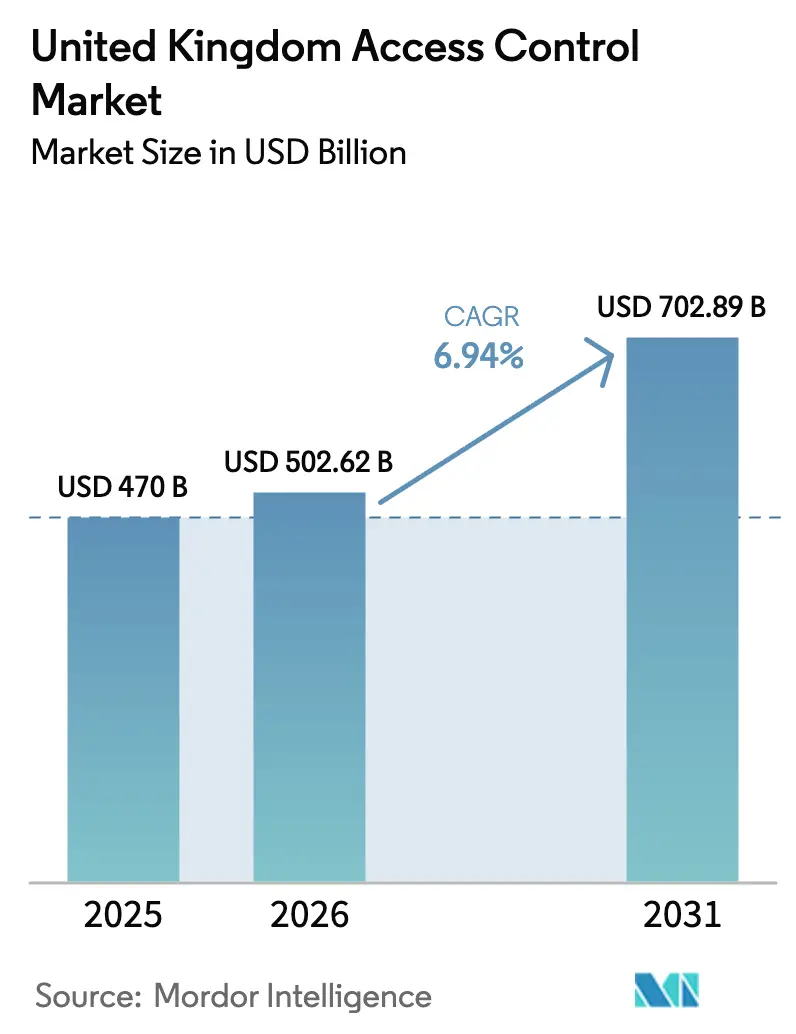
| Base Year Market Size (2025) | USD 470 Billion |
| Market Size (2026) | USD 502.62 Billion |
| Market Size (2031) | USD 702.89 Billion |
| Growth Rate (2026 - 2031) | 6.94 % |
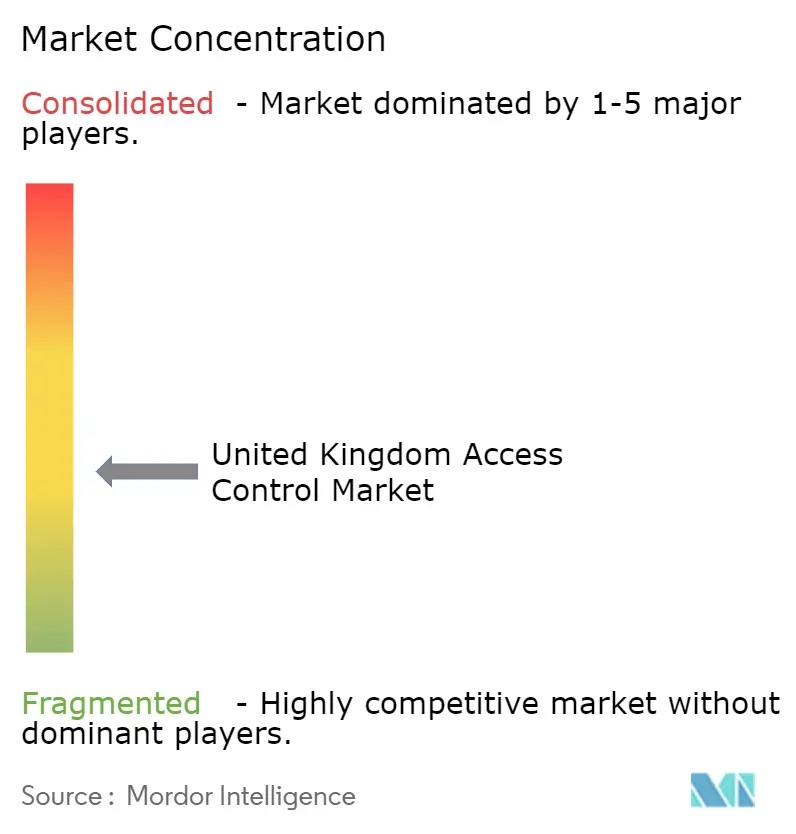
| Market Concentration | Medium |
Major Players *Disclaimer: Major Players sorted in no particular order Image © Mordor Intelligence. Reuse requires attribution under CC BY 4.0. | |
United Kingdom Access Control Market Analysis by Mordor Intelligence
The United Kingdom access control market size was valued at USD 470 million in 2025 and estimated to grow from USD 502.62 million in 2026 to reach USD 702.89 million by 2031, at a CAGR of 6.94% during the forecast period (2026-2031). The upward trajectory shows how rising security threats, evolving compliance rules, and the country’s status as a global financial hub keep physical identity management high on the corporate agenda. Hardware upgrades dominate spending because many buildings need new readers, controllers, and locks that support modern authentication. Cloud subscription models are winning favor as organizations seek lower capital outlays and continuous security patching. Demand also reflects tighter insurance requirements, more sophisticated organized crime tactics, and legislation such as Martyn’s Law that expands mandatory security coverage for public venues.[1]Security Industry Authority, “Martyn’s Law: the SIA's new regulatory role,” gov.uk Together, these shifts place sustained pressure on enterprises, campuses, and public-sector operators to modernize legacy door systems and embrace multi-factor approaches that blend cards, mobile phones, and biometrics. As a result, the United Kingdom access control market continues to show dependable mid-single-digit growth even when broader construction activity slows.
Key Report Takeaways
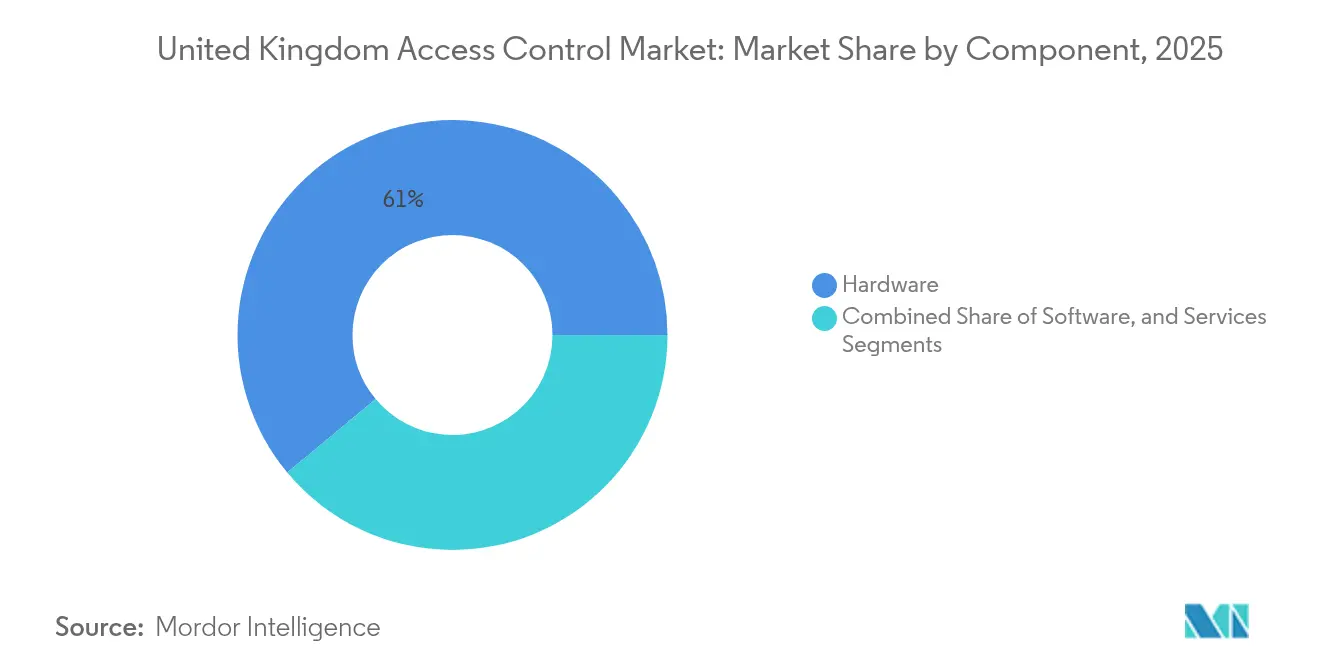
- By component, hardware held 61.05% of United Kingdom access control market share in 2025, while cloud/ACaaS software is forecast to grow at a 8.45% CAGR through 2031.
- By access-control model, RBAC led with 54.10% revenue share in 2025, whereas ABAC is projected to expand at a 8.86% CAGR.
- By authentication method, card-based credentials accounted for 45.70% of United Kingdom access control market size in 2025, and mobile credentials post the highest 9.74% CAGR to 2031.
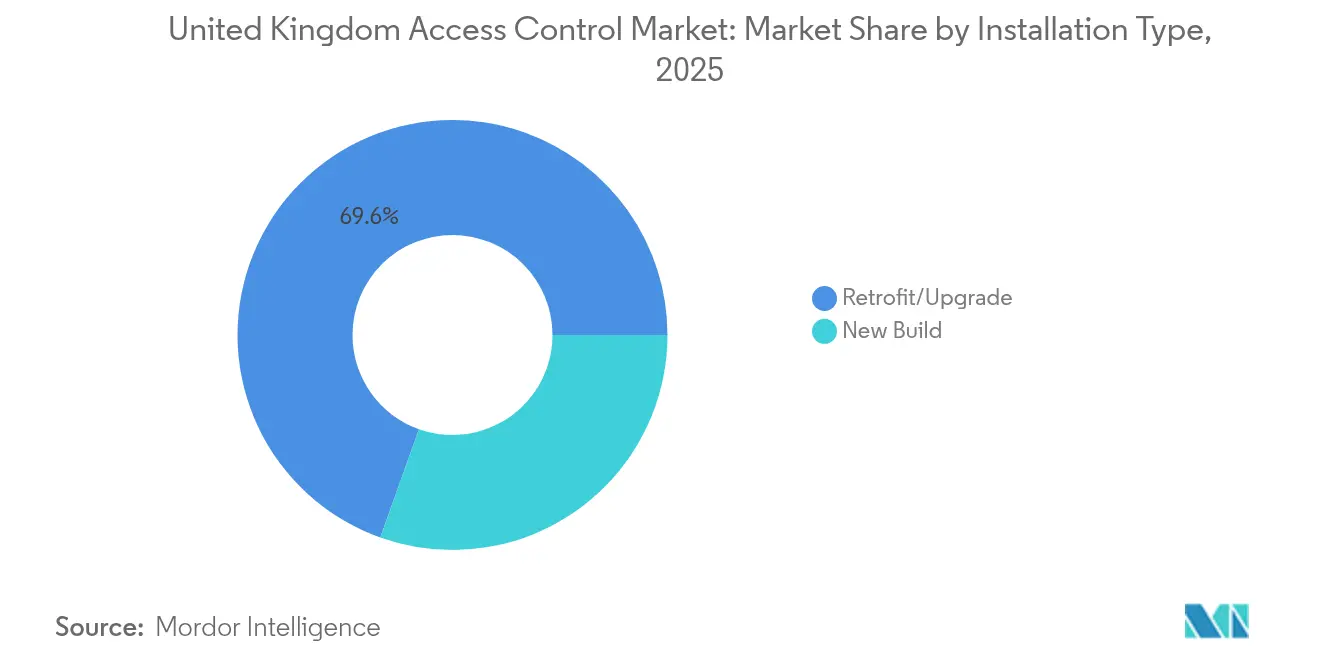
- By installation type, retrofit projects represented 69.55% of 2025 activity, with new-build installations advancing at a 7.38% CAGR over the forecast period.
- By end-use vertical, commercial buildings captured 40.22% share of the United Kingdom access control market size in 2025; healthcare and life sciences record the quickest 7.62% CAGR to 2031.
- By geography, England contributed 35.32% of 2025 revenue, while Northern Ireland is projected to grow at 7.09% CAGR through 2031.
Note: Market size and forecast figures in this report are generated using Mordor Intelligence’s proprietary estimation framework, updated with the latest available data and insights as of 2026.
United Kingdom Access Control Market Trends and Insights
Drivers Impact Analysis*
| Driver | (~) % Impact on CAGR Forecast | Geographic Relevance | Impact Timeline |
|---|---|---|---|
| Multi-factor authentication demand in London | +1.2% | London, South-East England | Short term (≤ 2 years) |
| “Secure by Design” regulations | +1.8% | England, Wales | Medium term (2-4 years) |
| Cloud migration of NHS door controllers | +0.9% | National, mainly England | Medium term (2-4 years) |
| Bluetooth uptake on university campuses | +0.7% | National, higher-education hubs | Short term (≤ 2 years) |
| Edge-AI pilots in Manchester & Milton Keynes | +0.5% | Manchester, Milton Keynes | Long term (≥ 4 years) |
| MOD open-protocol mandates | +0.4% | National, defense supply chain | Medium term (2-4 years) |
| Source: Mordor Intelligence | |||
Crime-linked demand for multi-factor authentication in London business districts
Metropolitan Police operations halved luxury watch thefts, yet organized crime keeps focusing on single-factor door systems. Financial firms in Westminster, Birmingham, and Manchester are adopting card-plus-biometric solutions to satisfy insurer requirements. The tighter security posture is creating a rapid pilot-to-rollout cycle and is likely to keep hardware and software refresh spending buoyant during 2025-2026.
Government backing for “Secure by Design” building regulations across England and Wales
The Product Security and Telecommunications Infrastructure Act and Martyn’s Law make baseline cybersecurity mandatory for connected devices and expand security duties to venues once exempt.[2]UK Government, “Regulations: consumer connectable product security,” gov.uk Builders must now show compliance at planning stage, shifting budgets from late-cycle retrofits to early design coordination. Although the new rules add 2-4% to project security outlays, early adopters report lower premiums that offset compliance costs. The measures broaden the United Kingdom access control market by pulling residential towers and mixed-use schemes into the customer base.
Cloud-first migration of legacy door controllers in NHS estates
NHS Digital’s partnership with IBM accelerates cloud SOC coverage over 1.2 million devices, pushing hospitals toward API-enabled controllers that integrate with patient-flow systems.[3]IBM, “NHS Digital | IBM,” ibm.com Data-sovereignty rules limit hosting to UK clouds, but subscription models appeal to budget-pressed trusts. Victorian hospitals with thick walls opt for wireless locks to minimize drilling, while procurement cycles of 18-24 months delay revenue recognition but provide long visibility for suppliers.
Uptake of Bluetooth credentials in United Kingdom university campuses
Heriot-Watt University’s campuswide rollout highlights the sector’s drive to cut plastic card costs by 40-60% and give overseas students a frictionless experience. Summer breaks create intense June–August demand peaks. Research labs still require biometrics, so integrators must deliver hybrid mobile-plus-reader designs. Opt-in privacy policies have produced dual credential regimes that raise system complexity yet improve satisfaction scores, reinforcing the move to mobile.
Restraints Impact Analysis*
| Restraint | (~) % Impact on CAGR Forecast | Geographic Relevance | Impact Timeline |
|---|---|---|---|
| GDPR penalties on video-integrated rollouts | –1.1% | National, EU-facing firms | Short term (≤ 2 years) |
| ROI doubts for biometrics in heritage sites | –0.8% | England, Scotland historic districts | Medium term (2-4 years) |
| Channel fragmentation across 4,000 installers | –0.6% | National, especially regional markets | Medium term (2-4 years) |
| Semiconductor lead-time volatility post-Brexit | –0.4% | National, import-dependent suppliers | Short term (≤ 2 years) |
| Source: Mordor Intelligence | |||
Stringent GDPR penalties slowing video-integrated access roll-outs
ICO guidance forces Data Protection Impact Assessments and explicit consent for biometric analytics, adding three to six months to projects. Enterprises now favor privacy-by-design architectures or postpone upgrades to avoid fines of up to 4% of global turnover. This caution curbs near-term demand for AI-enabled readers but fuels interest in edge devices that anonymize data on-site, creating a niche for privacy-preserving hardware.
ROI concerns for biometric retrofits in Victorian-era buildings
Listed-building consent requires reversibility, inflating per-door costs by 30-50% and stretching installation times by up to a year. Owners often prioritize energy or façade upgrades over security extras, dampening uptake in heritage districts. Mobile credentials and temporary kiosks offer partial fixes, but those workarounds deliver less protection and weaken the investment case for premium biometric kits.
*Our forecasts treat driver/restraint impacts as directional, not additive. The impact forecasts reflect baseline growth, mix effects, and variable interactions.
Segment Analysis
By Component: Hardware remains the anchor even as cloud expands
Hardware contributed 61.05% of 2025 revenue, confirming the foundational role of readers, locks, and controllers in the United Kingdom access control market. Electronic and smart locks posted the quickest unit growth because property managers want keyless convenience without wiring every door. Card readers still ship in volume, balancing user familiarity and robust performance. Biometric lenses and sensors penetrate high-risk zones only, while door controllers double as bridges that link new endpoints to legacy backbones.
Software, though smaller today, now records the steepest trajectory. Cloud/ACaaS subscriptions will grow 8.45% a year to 2031 as firms chase lower up-front spend and automatic patching. Managed services around installation, integration, and life-cycle support generate recurring fees, yet cut-throat bidding keeps margins tight. The convergence of physical and logical identity means integrators who master API security, fire-system links, and building-management data have higher earning potential.



By Access-Control Model: RBAC leads but ABAC gains ground
RBAC held 54.10% share in 2025 because HR systems feed roles straight into door permissions. That simplicity keeps administration costs low across large headcounts. The United Kingdom access control market is nevertheless tilting toward ABAC at a 8.86% CAGR, reflecting workplaces that need context-aware policies tied to device health, time of day, or real-time risk scores. Mandatory Access Control stays confined to defense domains, while Discretionary Access Control suits small companies that want minimal set-up overhead.
Hybrid architectures are emerging. Enterprises keep RBAC for everyday zones while layering ABAC around data centres or executive suites, mirroring their shift toward zero-trust. Cloud-native businesses show higher ABAC adoption than bricks-and-mortar incumbents, suggesting a generational hand-off that could redraw vendor share during the next refresh cycle.
By Authentication Method: Mobile disrupts but cards still rule on volume
Card credentials accounted for 45.70% of 2025 revenue because installed readers and badge issuance workflows remain entrenched. Yet mobile IDs on Bluetooth Low Energy and NFC will climb 9.74% a year thanks to smartphone ubiquity. Biometric scans grow at a steadier clip, mainly in regulated verticals, while PIN codes act as fallbacks for visitors.
Multi-factor combinations of phone plus face or phone plus PIN are rising fast, encouraged by insurers and regulators. This puts endpoint cybersecurity in the spotlight: if a handset is rooted, a door could be breached. Vendors are therefore integrating mobile device management hooks and secure credential vaults to reduce attack surfaces and reassure risk managers.
By Installation Type: Retrofit remains the dominant workload
Retrofit and upgrade projects made up 69.55% of 2025 deployments, underscoring the mature building stock that defines many UK city centres. Energy-efficiency grants and insurance audits frequently bundle security upgrades into wider refurbishments, creating strong cross-sell moments for integrators. Victorian masonry and occupied offices favour wireless locks and battery-powered handles because drilling is disruptive.
New-build activity is rebounding, on track for a 7.38% CAGR through 2031. Regulatory “Secure by Design” mandates mean security planning now starts at RIBA Stage 0 rather than post-handover, lifting unit values for new sites. Developers also want future-ready infrastructure that supports mobile and AI analytics, making higher-spec controllers the default instead of an optional extra.
By End-Use Vertical: Commercial stays in front while healthcare accelerates
Commercial real estate captured 40.22% of the United Kingdom access control market size in 2025. Office landlords and data-centre operators value scalable credentialing for tenants, contractors, and cleaning crews that changes daily. Retail malls also equip staff doors and service corridors to lower shrinkage risks. The healthcare and life-sciences cohort, however, is the fastest mover at 7.62% CAGR. NHS estates need to tie door events to patient-flow logs, and pharma labs face strict chain-of-custody duties that push them toward high-integrity audit trails.
Public sector demand grows in step with Martyn’s Law, which sweeps more venues, councils, and courts into the compliance net. Industrial plants lock down intellectual property and hazardous processes, while education institutions juggle student convenience with research-lab segregation, favouring flexible policy engines that merge mobile passes and biometrics.
Geography Analysis
England provided 35.32% of 2025 turnover for the United Kingdom access control market. London’s financial square mile drives premium deployments that pair multi-factor readers with cyber-security dashboards so physical alarms feed directly into SOC tooling. The South-East technology corridor stretches those needs into adjacent counties where data-centre and pharmaceutical campuses are clustering. England’s newer commercial parks embed access control inside integrated building platforms from day one, boosting software attach rates.
Scotland, Wales, and Northern Ireland add different texture. Edinburgh’s finance quarter and Glasgow’s engineering basin purchase advanced badge systems but often retrofit them into granite heritage blocks, requiring specialist mounts and wireless cylinders. Wales sees activity in Cardiff’s government precincts and manufacturing estates where EU supply-chain certification now includes stronger door audits. Northern Ireland, with the fastest 7.09% CAGR, benefits from cross-border commerce and harmonizing standards with Dublin, prompting logistics firms and tech parks to replace standalone locks with cloud-managed readers. Regional building age remains the chief adoption variable. Victorian terraces in London, Georgian crescents in Bath, and sandstone edifices in Aberdeen all limit hardwired cabling. That constraint lifts demand for battery handles, encrypted wireless mesh, and low-profile mullion readers that meet conservation rules. Defense work is heavily concentrated around Wiltshire, Cornwall, and segments of North-West England, creating micro-pockets of high-spec opportunity for MOD-compliant contractors. Brexit pushed some integrators to pivot toward local supply to dodge customs delays, strengthening domestic channel relationships in the north and in devolved nations where lead-time tolerance is lower.
Competitive Landscape
The United Kingdom access control market remains moderately fragmented even as headline acquisitions reshape the leader board. ASSA ABLOY’s agreement to buy Third Millennium Systems and 3millID for USD 21 million strengthens its biometric and middleware stack, marking a push into higher-security enterprise needs.[4]ASSA ABLOY, “ASSA ABLOY acquires 3millID and Third Millennium in the US and UK,” assaabloy.com Honeywell’s USD 4.95 billion purchase of Carrier’s Global Access Solutions business folds well-known LenelS2, Onity, and Supra lines into a broader building-automation suite.[5]Honeywell International Inc., “Honeywell completes acquisition of Carrier's Global Access Solutions business,” honeywell.gcs-web.com Bosch, meanwhile, is investing EUR 2.5 billion in artificial intelligence to infuse edge analytics across sensors and readers.
Despite consolidation, over 4,000 installer firms operate nationwide, and only 750 belong to the SIA’s Approved Contractor Scheme. That fragmentation creates pricing swings of 40-60% between counties and forces manufacturers to invest in partner training to protect brand reputation. The best-resourced integrators differentiate on cloud expertise, API security, and continuous service. Niche challengers exploit whitespace in heritage retrofits, SME subscription bundles, and converged cyber-physical management. The Approved Contractor badge is gradually turning into an entry ticket for public venue jobs now governed by Martyn’s Law, which may further accelerate shake-outs or roll-ups in the installer strata.
Cloud and mobile innovation are core to competitive positioning. Global vendors trumpet end-to-end encryption, UK-hosted redundancy, and password-less multifactor enrollment to answer GDPR and cyber-insurance scrutiny. Local specialists win projects that require bespoke fabrication, such as brass handles for listed buildings or ruggedized housings for rolling-stock doors, illustrated by dormakaba’s custom cab-door locks for West Midlands Trains. Strategic partnerships with telcos, AI start-ups, and cloud platforms serve as force multipliers, allowing hardware incumbents to claim full-stack capabilities without years of in-house R&D.
United Kingdom Access Control Industry Leaders
Suprema Inc.
Thales Group
Bosch Security Systems
Honeywell International Inc
Johnson Controls International PLC
- *Disclaimer: Major Players sorted in no particular order

Recent Industry Developments
- June 2025: Bosch announced over EUR 2.5 billion AI investment through 2027 for sensor-rich building security solutions.
- April 2025: The UK government published the AI Opportunities Action Plan with 50 sector-wide recommendations affecting smart-building deployments.
- April 2025: Martyn’s Law received Royal Assent, adding public-venue security duties under SIA oversight
- March 2025: The Cyber Security and Resilience Bill policy statement proposed a stronger framework for managed service providers and critical suppliers.
- February 2025: dormakaba partnered with West Midlands Trains on bespoke cab-door locks for rolling stock.
- February 2025: Oprema and EET Group acquired Advanced Access Ltd to enlarge their UK surveillance and security footprint.


United Kingdom Access Control Market Report Scope
The access control market encompasses systems and solutions tailored to govern resource access in computing environments. These technologies and services oversee permissions, authentications, and authorizations, bolstering security and compliance across diverse settings, from physical spaces like buildings and offices to digital realms such as networks and software applications.
The UK access control market is segmented by type (card reader & access control devices [card-based, proximity, smart card], biometric readers, electronic locks, software, and other types) and end-user vertical (commercial, residential, government, industrial, transport & logistics, healthcare, military & defense, and other end-users). The market sizes and forecasts are provided in terms of value (USD) for all the segments.
| Hardware | Card Readers | Magstripe and Proximity |
| Smart Card (Contact and Contactless) | ||
| Biometric Readers | Fingerprint | |
| Face Recognition | ||
| Iris and Other | ||
| Electronic/Smart Locks | Mechatronic Locks | |
| Digital/Smart Locks | ||
| Door Controllers and Keypads | ||
| Others (Turnstiles, Barriers, Key Cabinets) | ||
| Software | On-premise Platform | |
| Cloud/ACaaS | ||
| Services | Installation and Integration | |
| Support and Maintenance | ||
| Role-Based (RBAC) |
| Mandatory (MAC) |
| Discretionary (DAC) |
| Attribute-Based (ABAC) |
| Card-based Credentials |
| Biometric Credentials |
| Mobile/Digital Key (BLE, NFC) |
| PIN/Keypad Codes |
| Multi-factor/Hybrid |
| New Build |
| Retrofit/Upgrade |
| Commercial Buildings | Offices and Co-working | Retail and Shopping Centres |
| Data Centres | ||
| Residential | Single-family Homes | |
| Multi-family/Apartments | ||
| Government and Public Sector | Municipal Facilities | |
| Justice and Law Enforcement | ||
| Industrial and Manufacturing | Warehousing and Logistics | |
| Utilities and Energy | ||
| Transport and Critical Infrastructure | Airports and Seaports | |
| Rail and Metro Stations | ||
| Healthcare and Life Sciences | Hospitals and Clinics | |
| Pharmaceutical Labs | ||
| Education | K-12 Schools | |
| Higher Education and Research | ||
| Military and Defence | ||
| Other Verticals |
| England | London |
| South-East | |
| Midlands | |
| North England | |
| Scotland | |
| Wales | |
| Northern Ireland |
| By Component | Hardware | Card Readers | Magstripe and Proximity |
| Smart Card (Contact and Contactless) | |||
| Biometric Readers | Fingerprint | ||
| Face Recognition | |||
| Iris and Other | |||
| Electronic/Smart Locks | Mechatronic Locks | ||
| Digital/Smart Locks | |||
| Door Controllers and Keypads | |||
| Others (Turnstiles, Barriers, Key Cabinets) | |||
| Software | On-premise Platform | ||
| Cloud/ACaaS | |||
| Services | Installation and Integration | ||
| Support and Maintenance | |||
| By Access-Control Model | Role-Based (RBAC) | ||
| Mandatory (MAC) | |||
| Discretionary (DAC) | |||
| Attribute-Based (ABAC) | |||
| By Authentication Method | Card-based Credentials | ||
| Biometric Credentials | |||
| Mobile/Digital Key (BLE, NFC) | |||
| PIN/Keypad Codes | |||
| Multi-factor/Hybrid | |||
| By Installation Type | New Build | ||
| Retrofit/Upgrade | |||
| By End-Use Vertical | Commercial Buildings | Offices and Co-working | Retail and Shopping Centres |
| Data Centres | |||
| Residential | Single-family Homes | ||
| Multi-family/Apartments | |||
| Government and Public Sector | Municipal Facilities | ||
| Justice and Law Enforcement | |||
| Industrial and Manufacturing | Warehousing and Logistics | ||
| Utilities and Energy | |||
| Transport and Critical Infrastructure | Airports and Seaports | ||
| Rail and Metro Stations | |||
| Healthcare and Life Sciences | Hospitals and Clinics | ||
| Pharmaceutical Labs | |||
| Education | K-12 Schools | ||
| Higher Education and Research | |||
| Military and Defence | |||
| Other Verticals | |||
| By Geography | England | London | |
| South-East | |||
| Midlands | |||
| North England | |||
| Scotland | |||
| Wales | |||
| Northern Ireland | |||


Key Questions Answered in the Report
What is the projected value of the United Kingdom access control market by 2031?
It is expected to reach USD 702.89 million as the sector grows at a 6.94% CAGR through 2031.
Which component category holds the largest revenue share?
Hardware leads with 61.05% share because most buildings still require physical readers, locks, and controllers.
Why are mobile credentials gaining momentum in the United Kingdom access control industry?
Developers must show security compliance at the planning stage, shifting budgets from late-cycle retrofits to early integrated designs and boosting demand for cloud-ready controllers.
Which region is forecast to grow fastest, and why?
Northern Ireland at 7.09% CAGR, aided by cross-border trade, technology investment, and alignment with Republic of Ireland security standards.
How do “Secure by Design” rules affect new construction projects?
Developers must show security compliance at the planning stage, shifting budgets from late-cycle retrofits to early integrated designs and boosting demand for cloud-ready controllers.
What risk slows adoption of video-integrated readers?
Stringent GDPR penalties add months to project timelines, prompting risk-averse firms to delay or limit facial analytics rollouts.
Page last updated on:


 Your data is secure and never sold or shared.


