
UAE Retail Market Size and Share
Market Overview
| Study Period | 2022 - 2032 |
|---|---|
| Forecast Data Period | 2027 - 2032 |
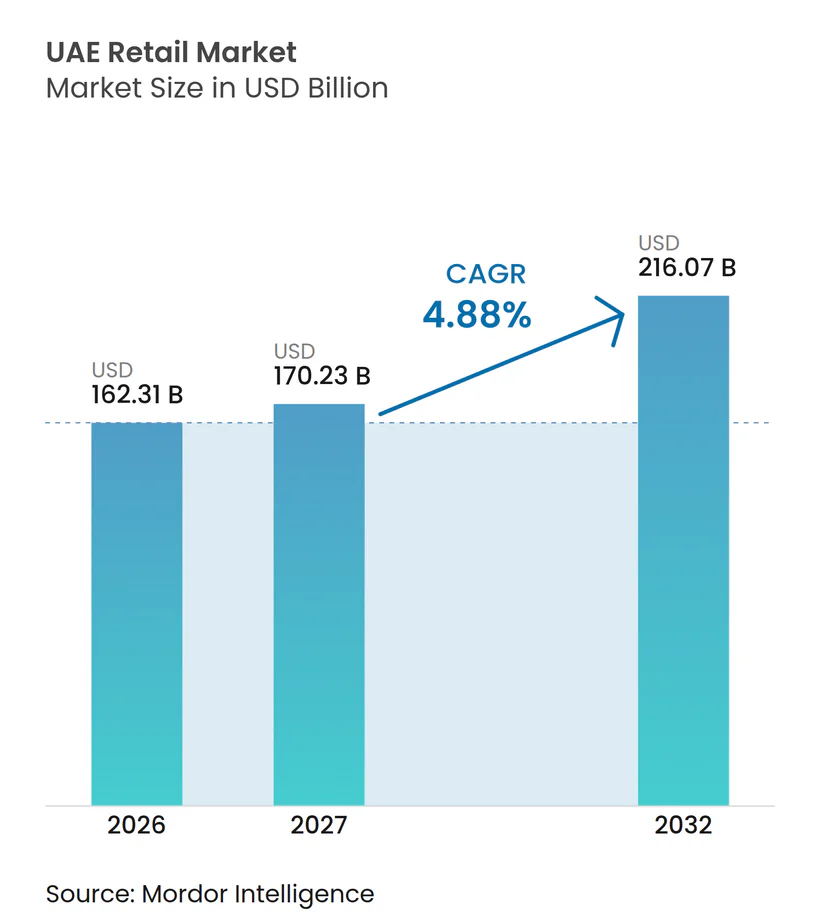
| Base Year Market Size (2026) | USD 162.31 Billion |
| Market Size (2027) | USD 170.23 Billion |
| Market Size (2032) | USD 216.07 Billion |
| Growth Rate (2027 - 2032) | 4.88 % |
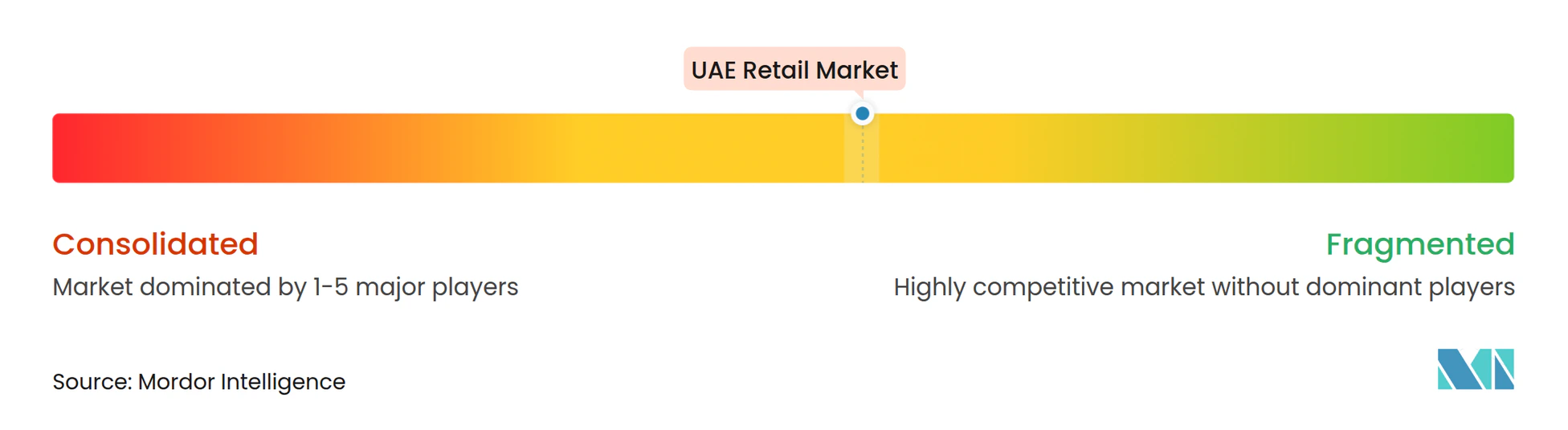
| Market Concentration | Medium |
Major Players *Disclaimer: Major Players sorted in no particular order Image © Mordor Intelligence. Reuse requires attribution under CC BY 4.0. | |
UAE Retail Market Analysis by Mordor Intelligence
The UAE retail market size was valued at USD 162.31 billion in 2026 and is estimated to grow from USD 170.23 billion in 2027 to reach USD 216.07 billion by 2032, at a CAGR of 4.88% during the forecast period (2027-2032). Wholesale and retail trade accounted for 16.1% of non-oil GDP, placing consumer-facing activity at the center of the country’s economic diversification agenda[1]. Population growth, expatriate inflows, tourism, and increasing digital purchases support demand across value and mass retail formats. The UAE retail market also benefits from a large visitor economy. However, operators face high occupancy costs in prime locations and rising delivery and return expenses. Retailers are responding by expanding loyalty programs and private-label offerings, implementing store-based fulfillment, accelerating delivery services, and investing in new malls and community retail formats.
Key Report Takeaways
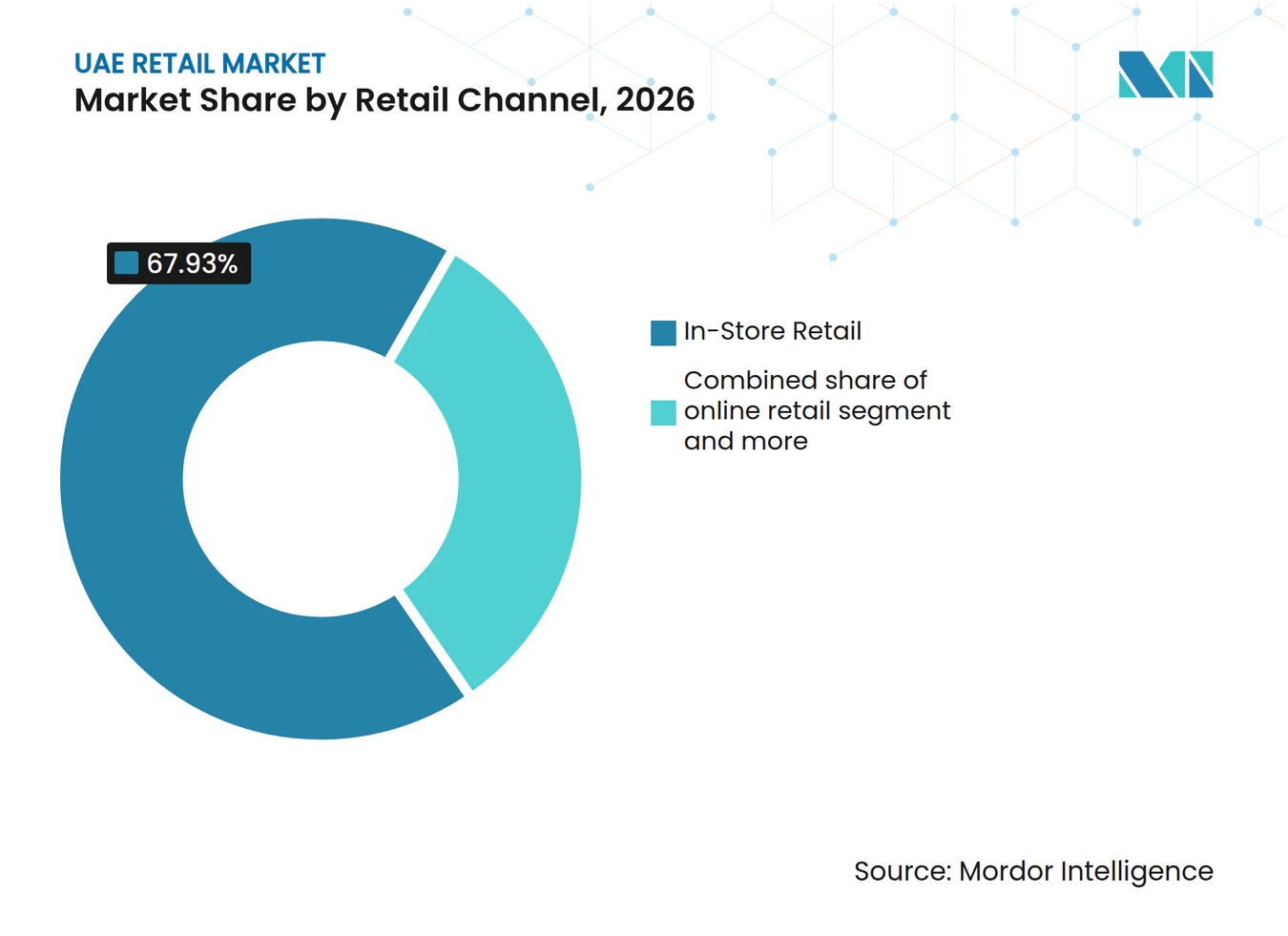
- By retail channel, in-store retail accounted for 67.93% of the UAE retail market share in 2026, while online retail is projected to grow at a 7.84% CAGR through 2032.
- By retail format, hypermarkets and supermarkets accounted for 35.82% of the UAE retail market size in 2026, while convenience stores are projected to grow at a 6.91% CAGR through 2032.
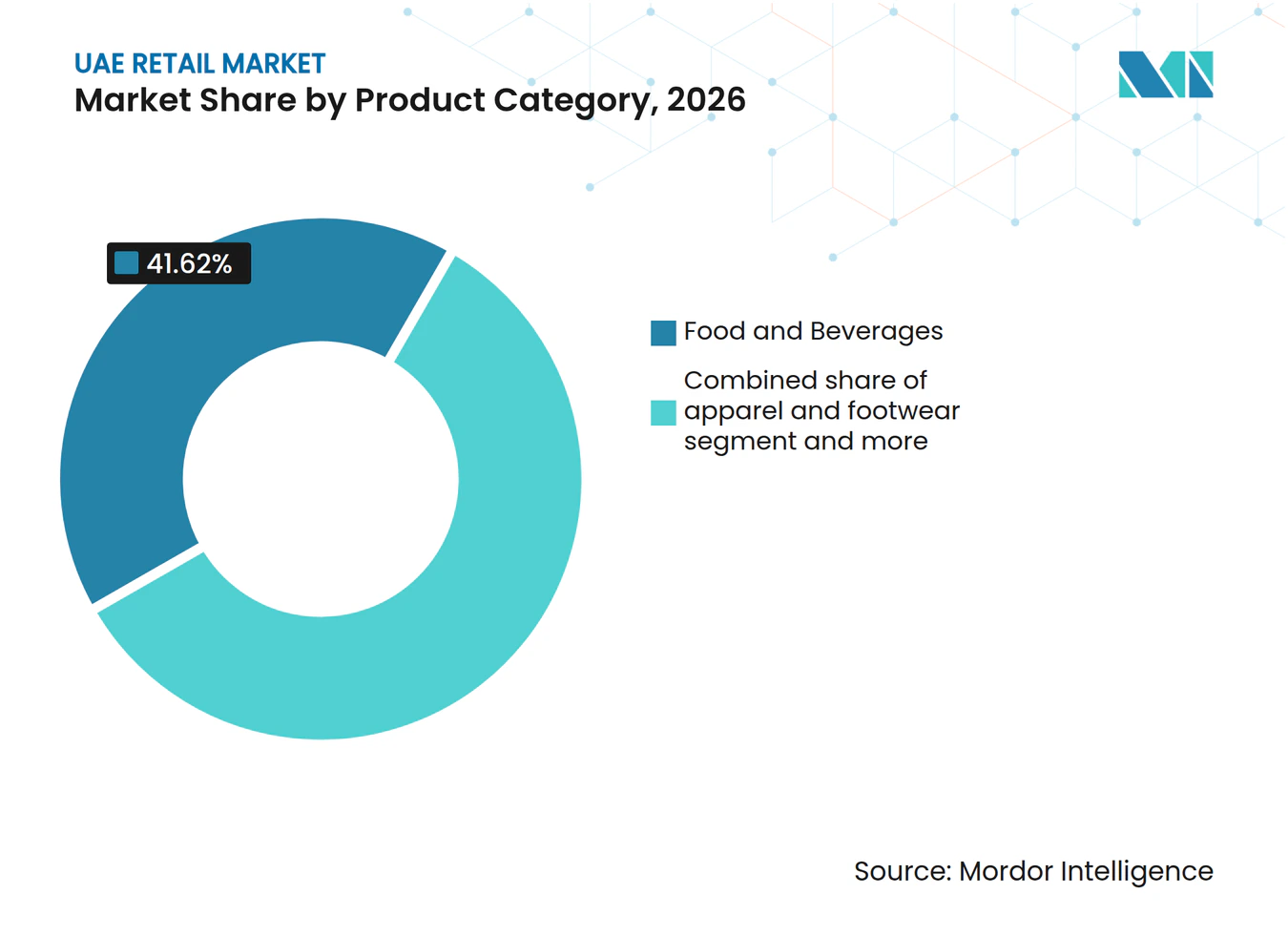
- By product category, food and beverages accounted for 41.62% of the UAE retail market size in 2026, while beauty, personal care, and health are projected to grow at a 6.83% CAGR through 2032.
- By geography, Dubai accounted for 46.77% of the UAE retail market share in 2026, while Abu Dhabi is projected to grow at a 6.56% CAGR through 2032.
Note: Market numbers in this report are based on Mordor Intelligence's proprietary estimation framework, which combines nine months of actuals with Q4 projections for base year 2026.
Market Trends and Insights
Drivers Impact Analysis of UAE Retail Market*
| Driver | (~) % Impact on CAGR Forecast | Geographic Relevance | Impact Timeline |
|---|---|---|---|
| Population Growth and Expatriate Inflows | +0.8% | National, with pronounced gains in Dubai and Abu Dhabi | Medium term (2-4 years) |
| Tourism-Led Retail and Experiential Spending | +0.9% | Dubai primary, with spillover to Abu Dhabi and Sharjah | Short term (≤ 2 years) |
| High Digital Commerce and Mobile Payment Adoption | +1.2% | National, with highest penetration in Dubai and Abu Dhabi | Medium term (2-4 years) |
| Omnichannel Retail and Store-as-Fulfillment-Hub Models | +0.5% | National, led by the Dubai logistics corridor | Medium term (2-4 years) |
| Premium, Luxury and Private-Label Polarization | +0.6% | Dubai, Abu Dhabi, and affluent areas of Sharjah | Long term (≥ 4 years) |
| Government-Led Digital Economy and Logistics Investment | +0.7% | National, anchored in Dubai South and Abu Dhabi Logistics City | Long term (≥ 4 years) |
| Source: Mordor Intelligence | |||
Population Growth and Expatriate Inflows
The UAE population reached 11.29 million in 2024, up 5.7% from the previous year[2]. Expatriates represented a substantial share of residents, supporting demand across value and mass-market retail offerings. This population mix drove varied demand for groceries, apparel, beauty products, and home goods rather than a single national consumption pattern. Newly arrived households initially increased demand for essential purchases, while higher-income residents supported discretionary categories and retail experiences. The UAE retail market depended on both the composition of population growth and the total number of residents.
Tourism-Led Retail and Experiential Spending
Dubai recorded 19.59 million international overnight visitors in 2025, a 5% increase from 2024 and its third successive record year[3]. International visitor spending in the UAE was expected to reach AED 228.5 billion (USD 62.20 billion) in 2025, exceeding the 2019 peak by 37%. Visitors support malls, luxury boutiques, food outlets, and entertainment-led retail destinations, especially in Dubai. Tourism also increases the value of physical retail because visitors often combine shopping with dining, leisure, and hotel stays. This pattern gives the UAE retail market a demand source that is distinct from resident spending.
High Digital Commerce and Mobile Payment Adoption
The UAE e-commerce sector reached AED 42.2 billion (USD 11.49 billion) in 2025 and represented 15.7% of total retail sales. E-commerce grew at a 19% CAGR between 2020 and 2025. Visa reported that 38% of UAE consumers made their most recent retail purchase remotely, indicating that online shopping is established in everyday purchasing behavior. Digital wallets and remote checkout options can simplify mobile transactions and help retailers serve time-sensitive shoppers. The UAE retail market is therefore shifting toward a channel mix in which physical stores and digital ordering cater to different shopping occasions.
Omnichannel Retail and Store-as-Fulfillment-Hub Models
Retailers use store inventory and local delivery networks to reduce delivery times without relying solely on dedicated warehouses. Apparel Group has outlined same-day delivery models using real-time store inventory and location-based fulfillment. Amazon launched Amazon Now in the UAE, offering 15-minute delivery of selected essentials through micro-fulfillment centers. ADNOC Distribution partnered with noon in April 2025 to use service-station locations for noon Minutes distribution and delivery. These models help retailers use existing sites, store staff, and local infrastructure more efficiently while raising customer expectations for product availability, delivery speed, and inventory accuracy.
Restraints Impact Analysis of UAE Retail Market*
| Restraint | (~) % Impact on CAGR Forecast | Geographic Relevance | Impact Timeline |
|---|---|---|---|
| Prime Retail Rent and Quality-Space Scarcity | -0.4% | Dubai Tier 1 malls and Abu Dhabi prime corridors | Medium term (2-4 years) |
| Delivery, Returns and Last-Mile Cost Pressure | -0.3% | National, with acute pressure in outer Dubai and remote emirates | Medium term (2-4 years) |
| Small Domestic Population and Expatriate Churn | -0.3% | National, concentrated in lower-income expatriate segments | Long term (≥ 4 years) |
| Price Sensitivity and Promotional Dependence | -0.2% | National, with the sharpest effect in value and mid-market formats | Medium term (2-4 years) |
| Source: Mordor Intelligence | |||
Prime Retail Rent and Quality-Space Scarcity
Prime retail space remains limited in leading malls, increasing occupancy costs for retailers seeking high-traffic locations. In its March 2026 investor presentation, Majid Al Futtaim reported 100% occupancy at Mall of the Emirates and 99% occupancy at City Center[4]. These high occupancy levels indicate strong leasing demand at the three malls and may limit the availability of vacant retail space for prospective tenants. Retailers unable to justify premium mall rents may opt for community locations, smaller store formats, or a greater online presence. High fixed property costs can also delay investments in store redesigns, new equipment, and customer-facing technologies.
Delivery, Returns and Last-Mile Cost Pressure
Fast delivery remains costly as customers expect short delivery windows, free returns, and service across multiple emirates. Amazon Now, noon Minutes, and other quick-commerce offerings have made delivery speed a more visible factor in retail competition. Retailers must balance delivery speed with order density, driver utilization, and return-handling costs. This challenge is greater outside densely populated urban areas, where lower order volumes are spread across longer routes. Shared delivery networks, lockers, and local pickup points can ease some pressure but do not eliminate the need for efficient order fulfillment.
*Our forecasts treat driver/restraint impacts as directional, not additive. The impact forecasts reflect baseline growth, mix effects, and variable interactions.
Consumer Behavior Analysis
Shopping behavior in the UAE varies seasonally, with malls serving as retail and leisure destinations and online channels supporting time-sensitive purchases. Visa’s Ramadan 2025 insights showed that retail accounted for 32% of international visitors’ in-store spending and dining for 25%. In-store spending increased during Ramadan’s final days, while online shopping peaked earlier. Retailers could align Ramadan collections, gift assortments, late-night campaigns, and dining-retail experiences with seasonal calendars and extended mall hours.
Digital shopping complemented physical retail. Visa Acceptance Solutions’ 2025 Global Digital Shopping Index - UAE Edition reported that 38% of surveyed consumers made their most recent retail purchase remotely. Online channels supported product research and comparison, while physical stores enabled product inspection and mall-based experiences. Retailers could support shopping tourists through mobile product information, consistent offers, multilingual assistance, and collection or delivery options.
Value, product differentiation, and wellness purchases offered opportunities in UAE retail. LuLu Retail’s FY 2025 annual report showed that private-label products represented 29.8% of its product mix, compared with 45.4% of Spinneys’ sales. The Global Wellness Institute’s 2025 UAE report valued the wellness economy at USD 40.8 billion in 2024, including USD 14.8 billion in personal care and beauty. Exclusive and locally distinctive products could appeal to budget-conscious shoppers and visitors seeking higher-value purchases.
Retail Performance Intelligence
UAE grocery retailers grew through higher transaction frequency, basket values, and regional scale. LuLu Retail generated USD 2.92 billion in UAE revenue in 2025, up 6.4% year-on-year. Spinneys reported AED 3.6 billion (USD 0.98 billion) in FY 2025 revenue and a 20.0% adjusted EBITDA margin. Its transactions increased 13.1% to 42.2 million, with an average basket value of AED 85.2 (USD 23.19). These metrics indicate opportunities in food retail, loyalty-driven repeat purchases, and convenient formats serving residents and visitors seeking quality local products.
Abu Dhabi’s retail leasing market showed tightening conditions in 2025, with overall retail occupancy rising from approximately 88% in 2021 to 94% in 2025. The Abu Dhabi Real Estate Centre’s 2025 market report also recorded an 8% year-on-year increase in new retail lease prices and a 19% increase in retail lease rates between 2020 and 2025. Average 2025 lease rates varied by format, from AED 1,583 (USD 430.94) per m² for street and community malls to AED 3,738 (USD 1,017.58) per m² for high-demand malls. This variation highlights the cost trade-off between premium visibility and more accessible locations. For shopping tourism, retailers must match site costs with target shoppers, product positioning, and expected visitor spending.
UAE Retail Market Segment Analysis
By Retail Channel:
Physical Formats Anchor Demand and Digital Gains ShareIn-store retail holds a 67.93% share in 2026, supported by malls’ role as climate-controlled shopping and leisure destinations. Physical outlets offer immediate product availability, personal service, food and entertainment, and seasonal experiences. This channel remains relevant for family visits, tourism spending, grocery stock-up trips, and higher-value shopping. High-quality malls also provide international brands with a controlled environment for product presentation. The UAE retail industry continues to rely on stores as sales points and brand-building locations.
Online retail is forecast to grow at a 7.84% CAGR through 2032, faster than other channels in the UAE retail market. The e-commerce sector reached AED 42.2 billion (USD 11.49 billion) in 2025, reflecting consumer acceptance of digital shopping. Retailers use stores as pickup points and local fulfillment sites to improve delivery speed and reliability. Online shopping supports replenishment, product comparison, and time-sensitive purchases. Growth will depend on delivery economics, inventory accuracy, customer trust, and returns management.



By Retail Format:
Hypermarkets Lead and Convenience Stores ExpandHypermarkets and supermarkets account for 35.82% of the UAE retail market size in 2026. Broad assortments, promotional capacity, and established supply chains support large household shopping trips. LuLu operates 43 UAE stores and generated USD 2.92 billion in UAE revenue in 2025, demonstrating the format’s scale. Carrefour, operated by Majid Al Futtaim, remains an important large-format grocery operator. Hypermarkets and supermarkets provide a core channel for food, household goods, and online order fulfillment.
Convenience stores are forecast to grow at a CAGR of 6.91% through 2032. The format meets demand for proximity, immediate consumption, smaller baskets, and late-hour access. Service stations and neighborhood locations place daily essentials near travel routes and residential areas. ADNOC Distribution’s partnership with noon adds quick-commerce capabilities to this network. Operators can combine food, personal care products, prepared meals, and delivery collection services in compact locations.
By Product Category:
Food Leads While Beauty, Personal Care, and Health Grow FastestFood and beverages accounted for 41.62% of retail sales in 2026. Daily consumption, foodservice-related purchases, and diverse dietary needs support the category. UAE grocery retail sales reached USD 18.2 billion in 2024, according to the USDA, supporting demand for packaged foods, fresh produce, imported products, and health-focused offerings. Retailers require localized assortments to address the cultural and dietary preferences of residents and visitors. Grocery remains central to omnichannel retail because it generates frequent orders and store visits.
Beauty, personal care, and health are forecast to grow at a 6.83% CAGR through 2032. The UAE wellness economy was valued at USD 40.8 billion in 2024, including USD 14.8 billion in personal care and beauty. This supports demand for skincare, beauty products, health-focused items, pharmacy-related products, and self-care services. Retailers serve this demand through specialty stores, department store counters, pharmacies, and online platforms. Product credibility, assortment quality, and customer guidance influence purchase decisions, as shoppers assess price and perceived value.

Geography Analysis
Dubai accounted for 46.77% of the UAE retail market in 2026. It recorded 19.59 million international overnight visitors in 2025, supporting luxury, fashion, food, and destination malls. Emaar’s planned AED 1.5 billion (USD 0.41 billion) District expansion at The Dubai Mall and Majid Al Futtaim’s AED 5 billion (USD 1.36 billion) Mall of the Emirates transformation reflect high-end retail demand. Abu Dhabi is forecast to grow at 6.56% CAGR through 2032. Aldar and Mubadala completed their AED 10 billion (USD 2.72 billion) joint venture in February 2026, combining Yas Mall and The Galleria Luxury Collection. Occupancy stood at 99% at Yas Mall and 92% at The Galleria. Sharjah and other emirates support community retail, value grocery, and traditional trade. City Centre Sharjah recorded 97% occupancy. Ajman, Ras Al Khaimah, Fujairah, Umm Al Quwain, and Al Ain offer convenience retail and branded grocery opportunities. 7X’s NXN network supports pickup and delivery through branches, lockers, and out-of-home points.
Retail Supply and Development Intelligence
The UAE retail network combines destination malls and expanding grocery chains, supporting tourist shopping and everyday purchases. Majid Al Futtaim’s March 2026 investor presentation reported 100% occupancy at Mall of the Emirates and 99% occupancy at City Centre Mirdif and City Centre Deira. Spinneys’ FY 2025 results reported 906,000 sq. ft. of gross selling area across the UAE and Saudi Arabia after 13 store openings. These figures reflect demand for established retail locations and continued network expansion. Shopping tourism opportunities include linking major malls with groceries, neighborhood retail, and visitor experiences.
UAE retail investment combines additional floor space with shopping and lifestyle experiences. Emaar’s AED 1.5 billion (USD 0.41 billion) Dubai Mall expansion includes 279 luxury outlets, while Majid Al Futtaim’s AED 5 billion (USD 1.36 billion) Mall of the Emirates transformation adds 20,000 m² of retail space and 100 stores. Aldar and Mubadala’s AED 10 billion (USD 2.72 billion) retail joint venture, completed in February 2026, brought Yas Mall and The Galleria Luxury Collection under Aldar’s management. LuLu identified a pipeline of 50 stores for 2026–2028. These developments support luxury itineraries, retail-linked dining, and cross-emirate shopping trips.
Competitive Landscape
Market Concentration
Shopping behavior in the UAE varies seasonally, with malls serving as retail and leisure destinations and online channels supporting time-sensitive purchases. Visa’s Ramadan 2025 insights showed that retail accounted for 32% of international visitors’ in-store spending and dining for 25%. In-store spending increased during Ramadan’s final days, while online shopping peaked earlier. Retailers could align Ramadan collections, gift assortments, late-night campaigns, and dining-retail experiences with seasonal calendars and extended mall hours.
Digital shopping complemented physical retail. Visa Acceptance Solutions’ 2025 Global Digital Shopping Index - UAE Edition reported that 38% of surveyed consumers made their most recent retail purchase remotely. Online channels supported product research and comparison, while physical stores enabled product inspection and mall-based experiences. Retailers could support shopping tourists through mobile product information, consistent offers, multilingual assistance, and collection or delivery options.
Value, product differentiation, and wellness purchases offered opportunities in UAE retail. LuLu Retail’s FY 2025 annual report showed that private-label products represented 29.8% of its product mix, compared with 45.4% of Spinneys’ sales. The Global Wellness Institute’s 2025 UAE report valued the wellness economy at USD 40.8 billion in 2024, including USD 14.8 billion in personal care and beauty. Exclusive and locally distinctive products could appeal to budget-conscious shoppers and visitors seeking higher-value purchases.
UAE Retail Industry Leaders
-
Majid Al Futtaim
-
LuLu Retail Holdings PLC
-
Amazon.ae
-
noon.com
-
Nesto Group International
- *Disclaimer: Major Players sorted in no particular order
UAE Retail Market Companies Covered in this Report
- Majid Al Futtaim
- LuLu Retail Holdings PLC
- Amazon.ae
- noon.com
- Al-Futtaim Group
- Alshaya Group
- Landmark Group
- Emaar Properties PJSC
- Nesto Group International
- Union Co-operative Society
- Sharjah Cooperative Society
- Spinneys Dubai LLC
- Al Maya Supermarkets
- West Zone Fresh
- Choithrams
- Azadea Group
- Apparel Group
- Chalhoub Group
- Al Tayer Group
- ENOC Group, ZOOM
Recent Industry Developments in UAE Retail Market
- February 2026: Aldar and Mubadala completed a AED 10 billion (USD 2.72 billion) retail joint venture in Abu Dhabi. Managed by Aldar, the platform combines Yas Mall and The Galleria Luxury Collection, with a total gross leasable area of 260,000 m².
- October 2025: Majid Al Futtaim announced Ghaf Woods Mall in Dubai. The mall anchors the AED 15.4 billion (USD 4.19 billion) Ghaf Woods residential community and represents the region’s first forest-integrated retail concept, expanding the company’s mall development activities into nature-inspired lifestyle formats.
- September 2025: 7X launched NXN, a national logistics network with more than 87 branches and 1,000 out-of-home pickup and drop-off locations. The network supports same-day and next-day deliveries for e-commerce retailers.
- January 2025: Al-Futtaim launched Blue AI within its Blue Rewards app in January 2025. The AI-powered lifestyle advisor covers fashion, beauty, and automotive categories.
UAE Retail Market Report Scope
The UAE Retail Market report analyzes retail sales across physical stores, online platforms, and omnichannel channels. The market is segmented by retail channel, retail format, product category, and geography, with separate market size and growth forecasts for Dubai, Abu Dhabi, Sharjah, and the rest of the UAE. The study assesses drivers such as population growth, expatriate inflows, tourism-led spending, digital commerce, mobile payments, omnichannel fulfilment, premium retail, and logistics investment. It also examines restraints including prime retail rents, delivery and last-mile costs, expatriate turnover, price sensitivity, and promotional dependence. The report evaluates retail store networks, floor space, new store openings, development pipelines, sales performance, space utilization, occupancy costs, consumer shopping behavior, channel preferences, spending patterns, and purchase frequency. It provides market size and growth forecasts by retail channel, format, product category, and geography for 2022–2032. The study also covers regulatory and technological developments, competitive forces, market concentration, market shares, strategic moves, and profiles of major retailers, e-commerce platforms, shopping mall operators, and retail groups. Opportunities in Arabic-first social commerce, AI-enabled retail media, personalized promotions, and tourist-focused luxury, duty-free, and experiential retail are also assessed. Market estimates and forecasts are presented in value terms across the covered segments.
Segmentation Overview
Key Questions Answered in the Report
What is the value of the UAE retail market in 2032?
It is forecast to reach USD 216.07 billion by 2032, growing at a 4.88% CAGR from 2027.
Which retail channel leads sales in the UAE?
In-store retail leads with 67.93% share in 2026, although online retail is forecast to grow at a 7.84% CAGR through 2032.
Which retail format is expanding fastest in the UAE?
Convenience stores are forecast to grow at a 6.91% CAGR through 2032 as shoppers seek closer, faster access to daily essentials.
Which product category has the largest share of UAE retail sales?
Food and beverages leads with a 41.62% share in 2026, supported by frequent daily purchases and a diverse resident population.
Which emirate has the fastest projected retail growth?
Abu Dhabi is forecast to grow at a 6.56% CAGR through 2032, supported by investment in Yas Mall and The Galleria Luxury Collection.
What is driving online shopping growth in the UAE?
E-commerce reached AED 42.2 billion (USD 11.49 billion) in 2025 and accounted for 15.7% of total retail sales.