
Aluminum Casting Market Size and Share
Market Overview
| Study Period | 2020 - 2032 |
|---|---|
| Market Size (2027) | USD 115.26 Billion |
| Market Size (2032) | USD 156.59 Billion |
| Growth Rate (2027 - 2032) | 6.32 % |
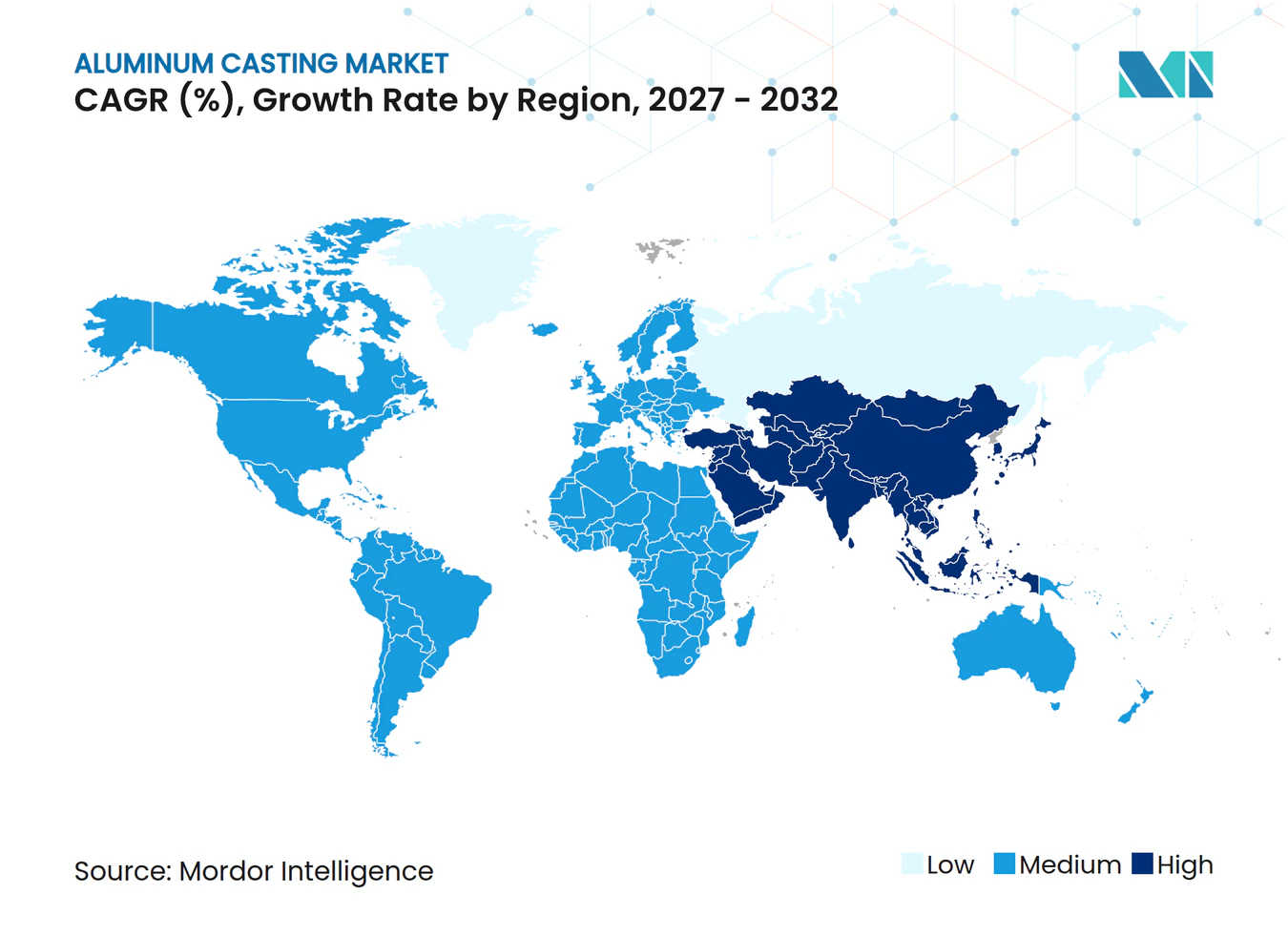
| Fastest Growing Market | Asia-Pacific |
| Largest Market | Asia-Pacific |
| Market Concentration | Medium |
Major Players *Disclaimer: Major Players sorted in no particular order Image © Mordor Intelligence. Reuse requires attribution under CC BY 4.0. | |
Aluminum Casting Market Analysis by Mordor Intelligence
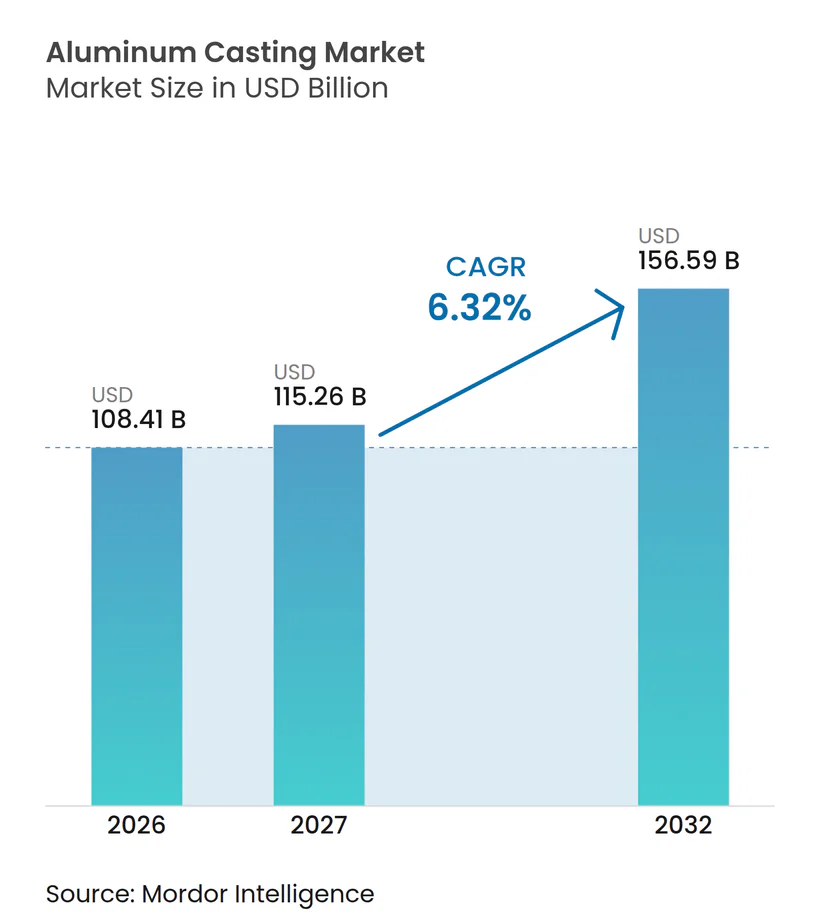
The aluminum casting market size was valued at USD 108.41 billion in 2026 and is estimated to reach USD 115.26 billion in 2027 and is projected to reach USD 156.59 billion by 2032, at a CAGR of 6.32% during the forecast period (2027-2032). The aluminum casting market is moving away from many smaller powertrain parts toward larger structural components for electric vehicle platforms. Aluminum remains well suited to this shift because it is light, castable, and recyclable when production tolerances can be maintained. Vehicle emissions rules, carbon-border measures, and circular-material requirements are bringing foundry investment closer to OEM electrification plans. This gives suppliers with vacuum casting, large presses, alloy engineering, and simulation capability a wider opportunity in the aluminum casting market. The same transition narrows participation because smaller foundries dependent on legacy powertrain work may not have the equipment or qualifications required for structural programs.
Key Report Takeaways
- By process, die casting held 61.27% of the aluminum casting market share in 2026, while sand casting is forecast to expand at a 7.01% CAGR through 2032.
- By alloy, Al-Si alloys held a 68.72% share in 2026, while Al-Mg alloys are forecast to expand at a 7.15% CAGR through 2032.
- By application, automotive accounted for 73.27% of the aluminum casting market size in 2026, while aerospace is forecast to expand at a 7.06% CAGR through 2032.
- By source, primary aluminum held a 63.27% share in 2026, while secondary and recycled aluminum is forecast to expand at a 7.34% CAGR through 2032.
- By geography, Asia-Pacific accounted for 36.71% of the aluminum casting market size in 2026 and is forecast to expand at a 7.27% CAGR through 2032.
Note: Market numbers in this report are based on Mordor Intelligence's proprietary estimation framework, which combines nine months of actuals with Q4 projections for base year 2026.
Market Trends and Insights
Drivers Impact Analysis of Aluminum Casting Market*
| Driver | (~) % Impact on CAGR Forecast | Geographic Relevance | Impact Timeline |
|---|---|---|---|
| Electric-Vehicle Lightweighting and Battery-Mass Offset | +2.0% | Global, concentrated in Asia-Pacific and North America | Short term (≤ 2 years) |
| Structural Integration and Gigacasting Adoption | +1.7% | Asia-Pacific core (China), spill-over to North America and Europe | Medium term (2–4 years) |
| Closed-Loop Recycled Aluminum Demand for Cast Components | +1.0% | Global; Europe regulatory pull, Asia-Pacific supply-side investment | Medium term (2–4 years) |
| Vehicle Emissions and Fuel-Economy Requirements | +0.9% | North America and Europe; India via CAFE norms | Short term (≤ 2 years) |
| Aerospace Lightweighting and Fleet Renewal | +0.6% | North America, Europe, Russia, growing in Asia-Pacific | Medium term (2–4 years) |
| Foundry Digitalization and AI-Assisted Yield Improvement | +0.6% | Global, with advanced adoption in Japan, Germany, and China | Long term (≥ 4 years) |
| Source: Mordor Intelligence | |||
Electric Vehicle Lightweighting and Battery-Mass Offset
Battery packs add vehicle weight and lead OEMs to reduce mass elsewhere in the body structure without compromising stiffness, safety, or assembly efficiency. This supports high-pressure die casting in the aluminum casting market because large integrated components can replace groups of stamped and welded parts, along with many associated fasteners and joining steps. A 2026 review reported that Tesla Model Y rear-underbody integration can reduce mass by up to 30% and direct manufacturing cost by up to 40% [1]. Battery trays also require leak-tight designs and consistent wall quality, which favors vacuum-assisted high-pressure die casting over processes with greater porosity risk. Research on vehicle electrification found that lightweighting, structural integration, and functional integration are expanding casting uses in electric vehicles [2]. The aluminum casting market therefore gains value per structural component even where the total number of cast pieces per vehicle declines and engineering requirements become more demanding.
Structural Integration and Gigacasting Adoption
Gigacasting uses presses of 6,000 tonnes or more to produce very large structural parts in a single shot, with each production cell requiring dedicated tooling, process control, and material handling. It allows an OEM to consolidate large assemblies into fewer castings and reduce joining operations, assembly variation, and floor-space requirements. The aluminum casting market benefits, as suppliers can provide the press capacity, vacuum systems, tooling, and process controls needed for these parts at repeatable production quality. EUROGUSS reported that battery-electric vehicles contain 10-40 aluminum cast parts, compared with 50-100 in internal-combustion vehicles. The lower part count can reduce demand for conventional component suppliers that rely on mature powertrain portfolios and smaller cast assemblies. It also increases the value of each qualified structural program and favors suppliers with strong engineering capability, validated processes, and the ability to work closely with OEM design teams.
Closed-Loop Recycled Aluminum Demand for Cast Components
OEM Scope 3 commitments and circular-material requirements are making secondary aluminum a strategic input rather than only a cost lever for casting procurement. A 2025 study found that AlSi10MnMg components containing up to 89% recycled content could achieve mechanical properties comparable to primary-alloy components. Heat treatment increased ductility in the tested material, though it also raised energy use and required careful process control. Oak Ridge National Laboratory introduced RidgeAlloy in 2025 to maintain structural performance with recycled blends containing higher iron and silicon levels [3]. The aluminum casting market can gain from certified recycled content as alloy qualification, scrap sorting, and traceability systems improve. Certification and traceability will determine which foundries can participate in OEM circular-supply programs and obtain the commercial benefit attached to verified low-carbon material.
Foundry Digitalization and AI-Assisted Yield Improvement
Casting yield is important because material and energy costs shape foundry profitability, particularly when scrap must be remelted or replaced by purchased metal. A 2025 IEEE review of 16 studies identified AI and IoT uses in defect detection, solidification-cycle optimization, and predictive maintenance for high-pressure die casting. The review also identified implementation cost, data quality, and the difficulty of scaling connected systems as practical barriers. The American Foundry Society began Aluminum Casting Performance Initiative projects in 2025, including machine-learning image recognition for diagnosing aluminum sand-casting defects. Digital process controls can help suppliers reduce scrap, shorten response times, and build a clearer record of part quality for demanding customers. In the aluminum casting market, this capability can become a condition for cost competitiveness rather than a discretionary upgrade for selected advanced plants.
Restraints Impact Analysis of Aluminum Casting Market*
| Restraint | (~) % Impact on CAGR Forecast | Geographic Relevance | Impact Timeline |
|---|---|---|---|
| Energy Intensity and Electricity-Price Volatility | -1.5% | North America and Europe; Japan; energy-import-dependent Asia-Pacific markets | Short term (≤ 2 years) |
| High Capital and Tooling Costs for Large-Format Casting | -1.0% | Global; most acute for non-OEM foundries in Europe and North America | Medium term (2–4 years) |
| Impurity and Porosity Risks in High-Recycled-Content Structural Castings | -0.7% | Global; restrains secondary aluminum penetration in safety-critical segments | Long term (≥ 4 years) |
| Repairability and Insurance Economics of One-Piece Structural Castings | -0.3% | Europe and North America, where collision-repair cost is an insurance underwriting variable | Medium term (2–4 years) |
| Source: Mordor Intelligence | |||
Energy Intensity and Electricity-Price Volatility
Melting uses a large share of energy in aluminum die casting, so changes in electricity and natural-gas prices can directly affect supplier margins and the quoted cost of long-running programs. The U.S. Energy Information Administration projected 2025 natural-gas costs delivered to power generators at USD 3.37 per million BTU, 24% higher than in 2024. European power costs remain a material challenge for foundries competing with lower-cost regions and operating under customer contracts that may limit price pass-through. A 2025 study modeled 4,000 energy-price scenarios and found that decarbonized aluminum configurations outperformed fossil-fuel baselines in only 50% of scenarios across a 25-year horizon. Long-term power agreements can reduce exposure, but they are easier for large integrated groups to secure because of their purchasing volumes and credit strength. The aluminum casting market may therefore see a cost advantage shift toward suppliers with stronger purchasing scale, energy planning, and access to stable electricity supply.
High Capital and Tooling Costs for Large-Format Casting
Large-format casting requires costly presses, dedicated tooling, auxiliary systems, and facilities near vehicle assembly plants, making the commitment more substantial than a conventional die-casting expansion. The investment is tied to specific vehicle programs because transporting very large castings over long distances is uneconomic and can create logistical complexity. This makes a delayed or canceled electric vehicle program difficult for an independent foundry to absorb, especially when equipment has limited alternate uses. EUROGUSS described how changes in vehicle program timing can reshape die-casting partnerships as the EV transition develops. Tool modifications can add further expense when a vehicle design changes during production or when OEM engineering teams adjust structural requirements. These constraints concentrate large structural-casting opportunities among OEM captive operations and well-capitalized Tier 1 suppliers with the balance-sheet capacity to manage program uncertainty.
*Our forecasts treat driver/restraint impacts as directional, not additive. The impact forecasts reflect baseline growth, mix effects, and variable interactions.
Aluminum Casting Market Segment Analysis
By Process:
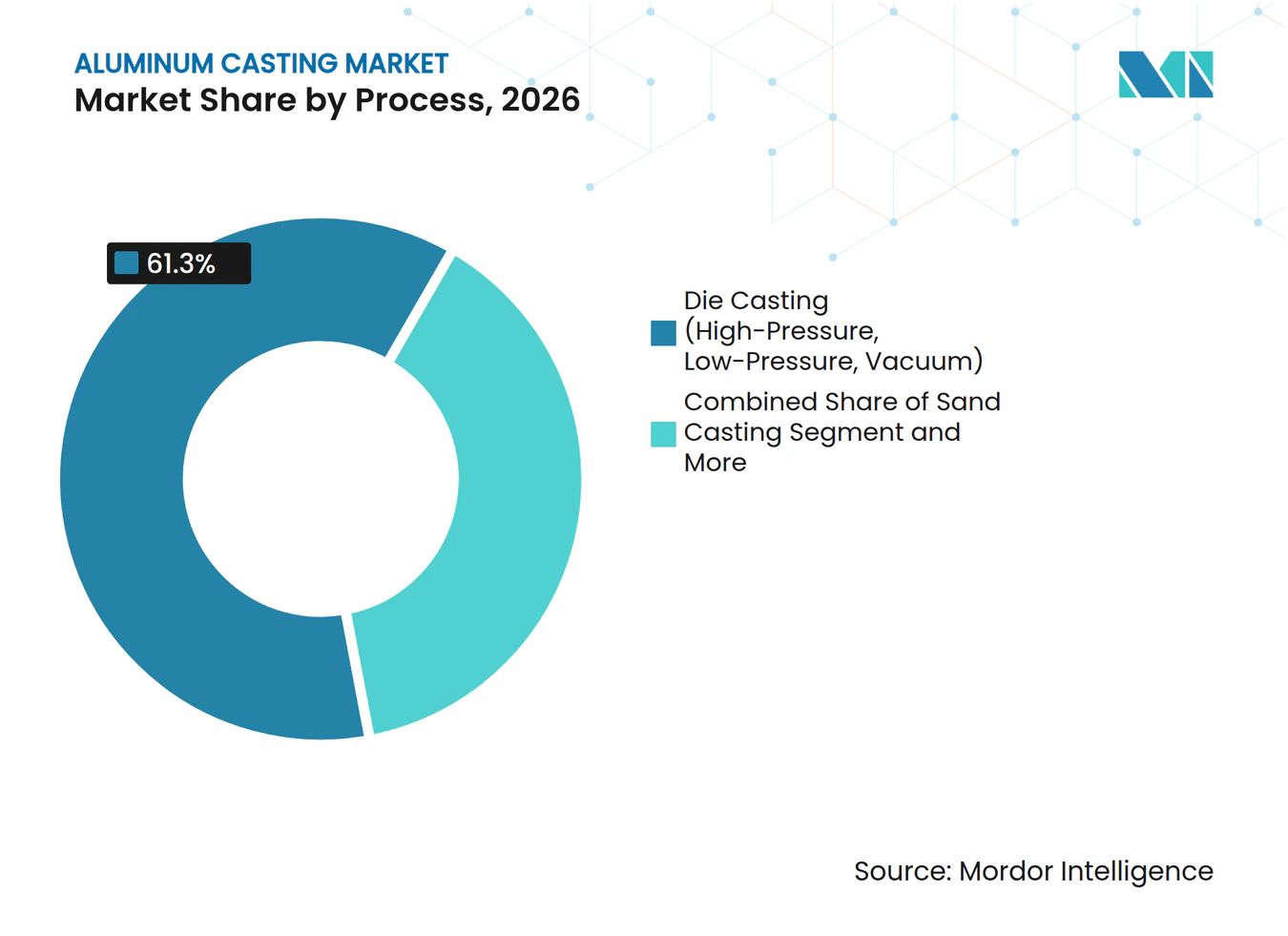
Die Casting Consolidates as Gigacasting Redefines ScaleDie casting held a 61.27% share in 2026, supported by high-pressure, low-pressure, and vacuum variants that meet different automotive, electronics, and industrial requirements. High-pressure die casting can serve smaller conventional parts and large structural castings when press tonnage, tooling, and process control are matched to the program. This gives established die casters a practical route into structural applications without replacing their basic manufacturing discipline. Sand casting is forecast to grow at a 7.01% CAGR through 2032 because it remains useful for complex, lower-volume geometries in aerospace and industrial machinery. The American Foundry Society’s 2025 ACPI work on machine-learning defect detection shows continuing quality investment in aluminum sand castings.
Gravity and permanent-mold casting retain a role in wheels and structural automotive components where controlled solidification supports mechanical properties. Investment casting remains relevant for complex aerospace parts produced in smaller runs, and additive-manufactured ceramic molds can reduce pattern-tooling limits for selected designs. Squeeze casting produces near-net-shape parts with limited porosity for safety-critical uses. The aluminum casting industry is not moving to one process alone because component size, required properties, volume, and tooling economics still differ by application. Volumes are concentrating in fewer large high-pressure shots, while aerospace and industrial demand continues to support a broad process mix.



By Alloy:
Al-Si Alloys Dominant but Al-Mg Gains in Heat-Free Structural CastingAl-Si alloys held a 68.72% share in 2026, with grades such as A380, A356, and ADC12 benefiting from well-established foundry infrastructure and automotive use. Their tolerance for impurities also supports secondary feed in many conventional castings. ADC12 remains widely used for powertrain and general-purpose die-casting applications in Asian markets. Al-Mg alloys are forecast to grow at a 7.15% CAGR through 2032 because heat-treatment-free processing can reduce distortion risk in thin-wall structural components. This makes them relevant for large integrated castings where dimensional stability matters after casting.
Al-Cu alloys retain a narrower role where high strength and heat resistance matter more than material cost. The important choice is between established silicon-dominant systems and heat-treatment-free systems suited to structural parts. RidgeAlloy, introduced by Oak Ridge National Laboratory in 2025, was designed for recycled blends with higher iron and silicon content while maintaining structural performance. Automotive qualification cycles remain important because suppliers must validate material performance before broad adoption. The aluminum casting market will balance new alloy performance with reliable supply, material traceability, and established quality systems.
By Application:
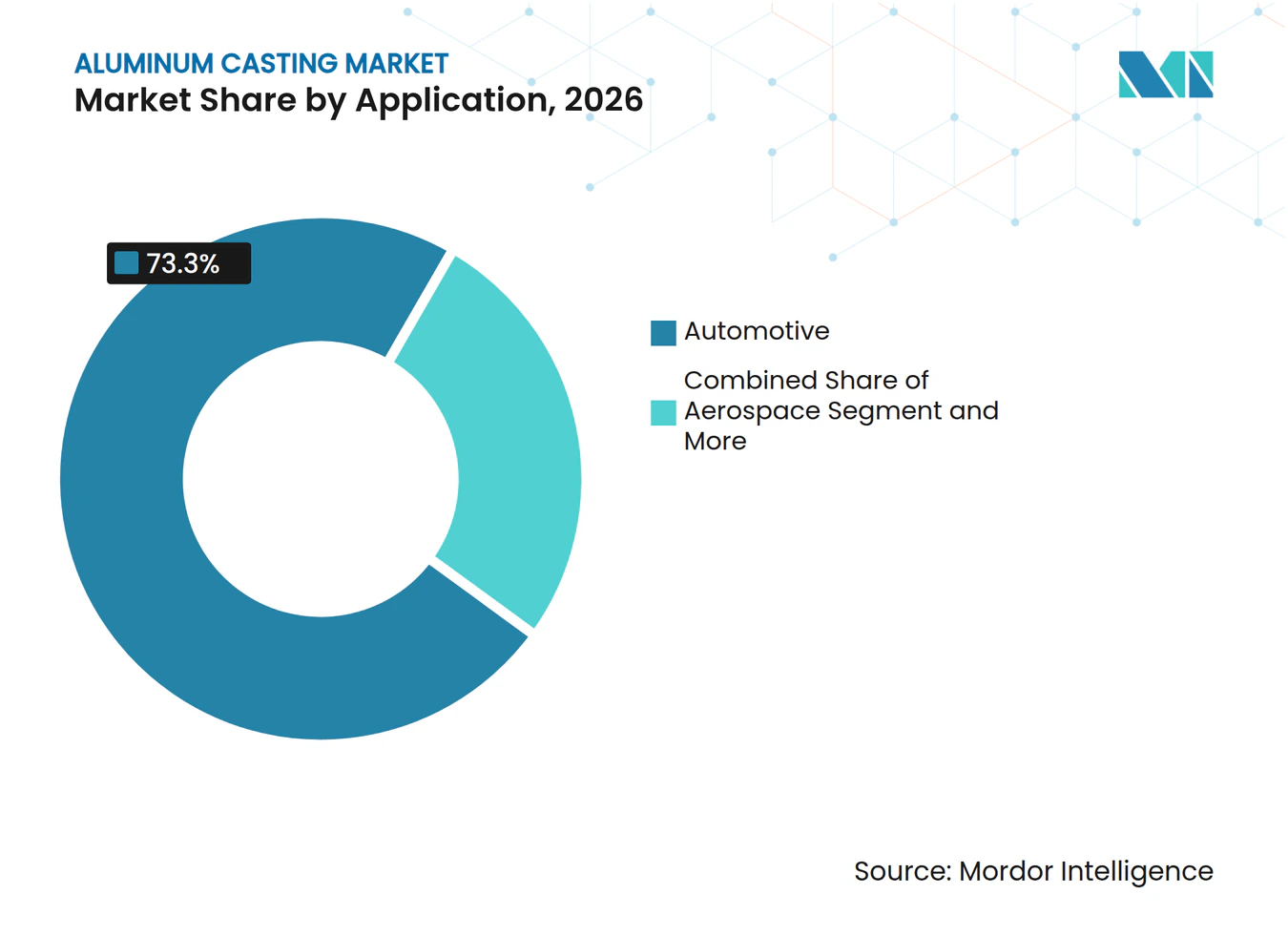
Automotive Commands Share as Aerospace AcceleratesAutomotive accounted for 73.27% of the aluminum casting market size in 2026, spanning engine blocks, transmission housings, structural castings, wheels, battery housings, and e-drive motor casings. Electric vehicles change the mix of automotive demand rather than eliminating it, as battery housings and e-drive casings supplement declining multi-component powertrain assemblies. Industrial machinery, construction, and consumer electronics remain stable volume outlets for aluminum castings. Consumer-electronics housings and communications equipment use precision die casting and can provide demand diversity for suppliers exposed to automotive cycles. This broad application base remains important to the aluminum casting industry because it supports utilization across different customer sectors.
Aerospace is forecast to grow at a 7.06% CAGR through 2032, supported by aircraft delivery backlogs and fleet renewal. Airbus described a 2025 circularity initiative focused on recovering titanium and aluminum from retired aircraft. Constellium and TARMAC Aerosave also reported successful recovery and remelting of aluminum from decommissioned aircraft for new aerospace manufacturing. Aerospace qualification standards such as AS9100 make entry difficult but support high-value programs for qualified suppliers. The aluminum casting market can therefore diversify beyond automotive cycles, although aerospace demand remains linked to aircraft build rates and fleet replacement decisions.

By Source:
Secondary Aluminum Closes the Gap on PrimaryPrimary aluminum held 63.27% of the aluminum casting market share by source in 2026 because structural applications require consistent chemistry and high ductility. Secondary and recycled aluminum is forecast to grow at a 7.34% CAGR through 2032 as alloy design, scrap sorting, and process controls advance. A 2025 study of high-pressure die-cast AlSi10MnMg assessed recycled content from 0% to 89% and found acceptable castability and weldability within structural tolerances. This supports wider use of secondary feed in applications where the process can manage variation in incoming material. It also supports OEM efforts to reduce material-related emissions.
Recycling aluminum can save 95% of the energy used for primary smelting, which supports cost and environmental objectives. Large structural castings still require closely controlled trace-element chemistry, which can favor primary metal in demanding applications. Research on electrification noted the tension between demand for high-ductility primary alloys and the drive to increase recycled content. Secondary material can progress first in nonstructural casings, enclosures, consumer products, and lower-stress structural applications. The aluminum casting market can support parallel growth in primary and secondary sources as material certification and alloy qualification mature.
Geography Analysis
Asia-Pacific: The Market's Largest and Fastest-Growing Region
Asia-Pacific held a 36.71% share in 2026 and is forecast to grow at a 7.27% CAGR through 2032. China combines a large automotive base with rapid integrated die-casting investment, creating demand for structural components and conventional cast products. The regional supplier ecosystem also benefits from EV production, consumer electronics, and a large base of local equipment and material suppliers. China’s NEV Technology Roadmap supports lightweighting and lower vehicle emissions, while Japan and India add advanced die-casting capability and demand from automotive electrification. Suppliers across the region compete on scale, cost control, material qualification, and close relationships with vehicle producers.
Europe: Cautious OEM Adoption, Proven Gigacasting Benchmark
Europe remains a major casting region, supported by automotive production and a broad base of established suppliers. German OEMs have an entrenched stamping and welding supply chain, which can make their shift to large integrated castings more measured than in some Asian programs. Energy exposure remains a material operating issue for European foundries. The EU End-of-Life Vehicles Regulation and Carbon Border Adjustment Mechanism create compliance factors that favor low-carbon and recycled-content supply chains. ISO 9001 and IATF 16949 remain central quality requirements for automotive casting suppliers.
Smaller Regions Gain Structural Importance
North America is moving from gigacasting evaluation toward early deployment in upcoming EV programs, while Mexico benefits from proximity to OEM assembly sites. South America is anchored by Brazil’s automotive base, and the Middle East seeks to link aluminum-smelting capacity with downstream component manufacturing. Africa, led by South Africa and Morocco, remains early-stage but can benefit from near-shoring by European OEMs. These mixed regions widen the aluminum casting market supply map, even though their structural-casting capabilities remain less mature than those in Asia-Pacific and Europe.
Competitive Landscape
Market Concentration
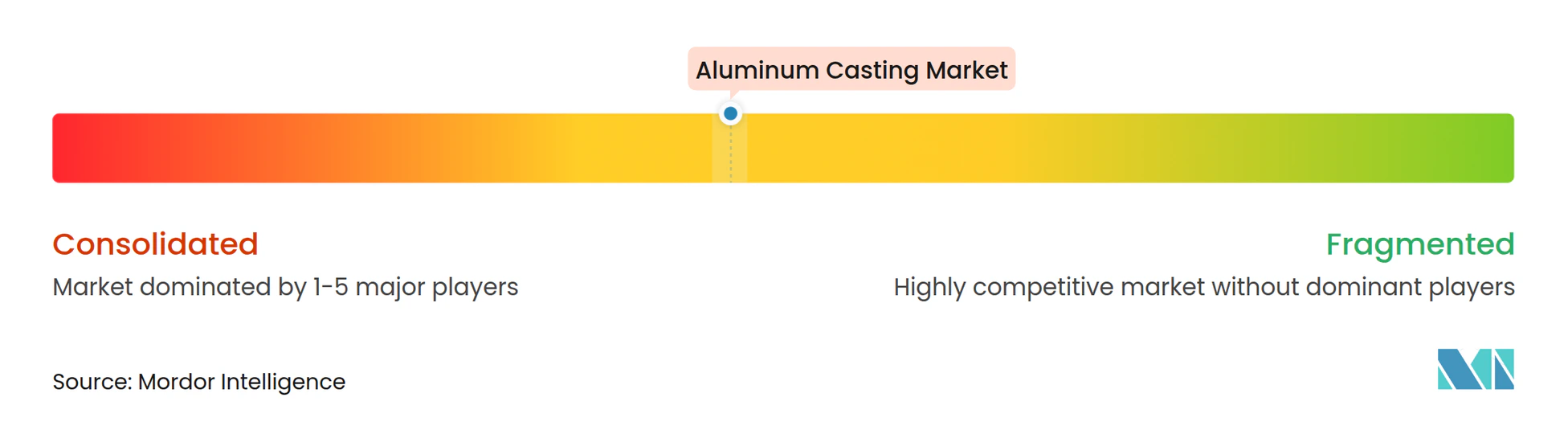
The aluminum casting market is moderately concentrated among the largest structural-casting suppliers and fragmented across regional specialists. High-tonnage presses, vacuum systems, simulation capability, tooling expertise, and OEM approval create meaningful entry barriers in large castings. These requirements favor suppliers with strong capital resources and established customer relationships. Nemak completed the acquisition of GF Casting Solutions’ automotive business in February 2026, adding 9 manufacturing facilities across Germany, Austria, China, Romania, and the United States, plus an R&D center in Switzerland. The transaction reflects the value of broader production footprints and technical capabilities for structural programs.
Technology differentiation is becoming as important as press tonnage. Alcoa’s EZCast C891F alloy received NADCA innovation recognition in October 2025 for a Xiaomi YU7 front-cabin casting that replaced more than 20 steel stampings. Alloy properties influence part performance, repairability, and OEM qualification. Wencan Group brought its Foshan gigacasting plant into operation in late 2025, with equipment from 2,200 to 12,000 tonnes. The capacity serves Chinese EV demand for motor housings, battery trays, body castings, and underbody components.
Smaller precision die casters remain relevant in consumer electronics, medical devices, and two-wheeler applications. Automotive suppliers must meet ISO 9001 and IATF 16949 requirements, while aerospace suppliers face AS9100 and material-data requirements. The aluminum casting market is likely to retain a long tail of regional suppliers even as a smaller group leads the highest-value structural work. The market concentration score is 6 out of 10 because the 7 leading players are estimated to hold 63% of aluminum die-casting revenue, while a large regional supplier base remains active.
Aluminum Casting Industry Leaders
-
Nemak, S.A.B. de C.V.
-
Ryobi Limited
-
Georg Fischer AG
-
Endurance Technologies Limited
-
Rheinmetall AG
- *Disclaimer: Major Players sorted in no particular order
Aluminum Casting Market Companies Covered in this Report
- Nemak, S.A.B. de C.V.
- Ryobi Limited
- Georg Fischer AG
- Endurance Technologies Limited
- Rheinmetall AG
- Ahresty Corporation
- Form Technologies, Inc.
- Martinrea International Inc.
- Linamar Corporation
- Koch Enterprises, Inc.
- Pace Industries, LLC
- Shiloh Industries, Inc.
- TVS Holdings Limited
- Hero Motors Company
- Wencan Group Co., Ltd.
- Guangdong Hongtu Technology (Holdings) Co., Ltd.
- IKD Co., Ltd.
- Alcoa Corporation
- Consolidated Metco, Inc.
- Aisin Corporation
Recent Industry Developments in Aluminum Casting Market
- February 2026: Global casting giant Nemak completed the landmark USD 336 million acquisition of GF Casting Solutions’ automotive casting business unit. This acquisition strengthens Nemak’s capabilities in producing large structural components for electric vehicle platforms.
- August 2026: Jaya Hind Industries Pvt. Ltd. (JHI), a fully vertically integrated company and leading global supplier of precision aluminum die-cast components, announced a phased investment of INR 600 crore (USD 62.95 million) over the following two years. The investment aimed to strengthen the company’s manufacturing capabilities and capacity in high-pressure die casting (HPDC) and gravity die casting (GDC).
Global Aluminum Casting Market Report Scope
Aluminum Casting Market is segmented by Process, Alloy, Application, Source, and Geography. By Process, the market is segmented into Die Casting (High-Pressure, Low-Pressure, Vacuum), Gravity / Permanent Mold Casting, Sand Casting, Investment Casting, Squeeze Casting, and Other Processes. By Alloy, the market is segmented into Al-Si Alloys (A380, A356, ADC12), Al-Cu Alloys, Al-Mg Alloys, and Other Alloys. By Position, the market is segmented into Front Windshield and Rear Windshield (Backlite). By Application, the market is segmented into Automotive (Engine Blocks, Transmission Housings, Structural / Gigacasting, Wheels, Battery Housings), Aerospace, Industrial Machinery, Building and Construction, Consumer Electronics and Telecom, and Other Applications. By Source, the market is segmented into Primary Aluminum and Secondary / Recycled Aluminum. By Geography, the market is segmented into North America (United States, Canada, Mexico, and Rest of North America), Europe (Germany, France, Italy, United Kingdom, Spain, Russia, and Rest of Europe), Asia-Pacific (China, India, Japan, South Korea, Australia, Indonesia, Thailand, and Rest of Asia-Pacific), South America (Brazil, Argentina, Colombia, Chile, and Rest of South America), and Middle East and Africa (Saudi Arabia, United Arab Emirates, Israel, Türkiye, South Africa, Morocco, and Rest of Middle East and Africa). Market forecasts are provided in terms of Value (USD) and Volume (Tons).
Segmentation Overview
| Die Casting (High-Pressure, Low-Pressure, Vacuum) |
| Gravity / Permanent Mold Casting |
| Sand Casting |
| Investment Casting |
| Squeeze Casting |
| Other Processes |
| Al-Si Alloys (A380, A356, ADC12) |
| Al-Cu Alloys |
| Al-Mg Alloys |
| Other Alloys |
| Automotive (Engine Blocks, Transmission Housings, Structural / Gigacasting, Wheels, Battery Housings) |
| Aerospace |
| Industrial Machinery |
| Building and Construction |
| Consumer Electronics and Telecom |
| Other Applications |
| Primary Aluminum |
| Secondary / Recycled Aluminum |
| North America | United States |
| Canada | |
| Mexico | |
| Rest of North America | |
| Europe | Germany |
| France | |
| Italy | |
| United Kingdom | |
| Spain | |
| Russia | |
| Rest of Europe | |
| Asia-Pacific | China |
| India | |
| Japan | |
| South Korea | |
| Australia | |
| Indonesia | |
| Thailand | |
| Rest of Asia-Pacific | |
| South America | Brazil |
| Argentina | |
| Colombia | |
| Chile | |
| Rest of South America | |
| Middle East and Africa | Saudi Arabia |
| United Arab Emirates | |
| Israel | |
| Turkey | |
| South Africa | |
| Morocco | |
| Rest of Middle East and Africa |
| By Process | Die Casting (High-Pressure, Low-Pressure, Vacuum) | |
| Gravity / Permanent Mold Casting | ||
| Sand Casting | ||
| Investment Casting | ||
| Squeeze Casting | ||
| Other Processes | ||
| By Alloy | Al-Si Alloys (A380, A356, ADC12) | |
| Al-Cu Alloys | ||
| Al-Mg Alloys | ||
| Other Alloys | ||
| By Application | Automotive (Engine Blocks, Transmission Housings, Structural / Gigacasting, Wheels, Battery Housings) | |
| Aerospace | ||
| Industrial Machinery | ||
| Building and Construction | ||
| Consumer Electronics and Telecom | ||
| Other Applications | ||
| By Source | Primary Aluminum | |
| Secondary / Recycled Aluminum | ||
| By Geography | North America | United States |
| Canada | ||
| Mexico | ||
| Rest of North America | ||
| Europe | Germany | |
| France | ||
| Italy | ||
| United Kingdom | ||
| Spain | ||
| Russia | ||
| Rest of Europe | ||
| Asia-Pacific | China | |
| India | ||
| Japan | ||
| South Korea | ||
| Australia | ||
| Indonesia | ||
| Thailand | ||
| Rest of Asia-Pacific | ||
| South America | Brazil | |
| Argentina | ||
| Colombia | ||
| Chile | ||
| Rest of South America | ||
| Middle East and Africa | Saudi Arabia | |
| United Arab Emirates | ||
| Israel | ||
| Turkey | ||
| South Africa | ||
| Morocco | ||
| Rest of Middle East and Africa | ||
Key Questions Answered in the Report
What is the forecast growth rate for aluminum casting through 2032?
The sector is forecast to grow at a 6.32% CAGR from 2027 to 2032, reaching USD 156.59 billion in 2032. The forecast reflects growing structural-casting demand and wider use of aluminum in vehicle electrification.
Why are electric vehicles changing aluminum casting demand?
Electric vehicles require lightweight structures, battery housings, and e-drive motor casings. Integrated castings can replace many stamped and welded parts, increasing the value of qualified structural components.
Which aluminum casting process has the largest share?
Die casting leads with a 61.27% share in 2026. High-pressure and vacuum processes are important for automotive, battery, and structural applications that require consistent dimensional control.
Which application is growing the fastest in aluminum casting?
Aerospace is forecast to grow at a 7.06% CAGR through 2032, supported by aircraft deliveries and fleet modernization. The sector also supports higher-value, tightly qualified component programs.
Why is recycled aluminum becoming more important for cast components?
OEM carbon commitments and improved alloy design are supporting recycled feed, which is forecast to grow at a 7.34% CAGR through 2032. Certification and traceability will remain important for structural use.
Which region leads aluminum casting demand and growth?
Asia-Pacific held a 36.71% share in 2026 and is forecast to grow at a 7.27% CAGR through 2032. China, Japan, and India support regional demand through different automotive and manufacturing strengths at scale, with integrated supply networks, continued local production investment, and growing needs for qualified structural and conventional components across regional manufacturing hubs over the forecast period.